
Redshift residuals
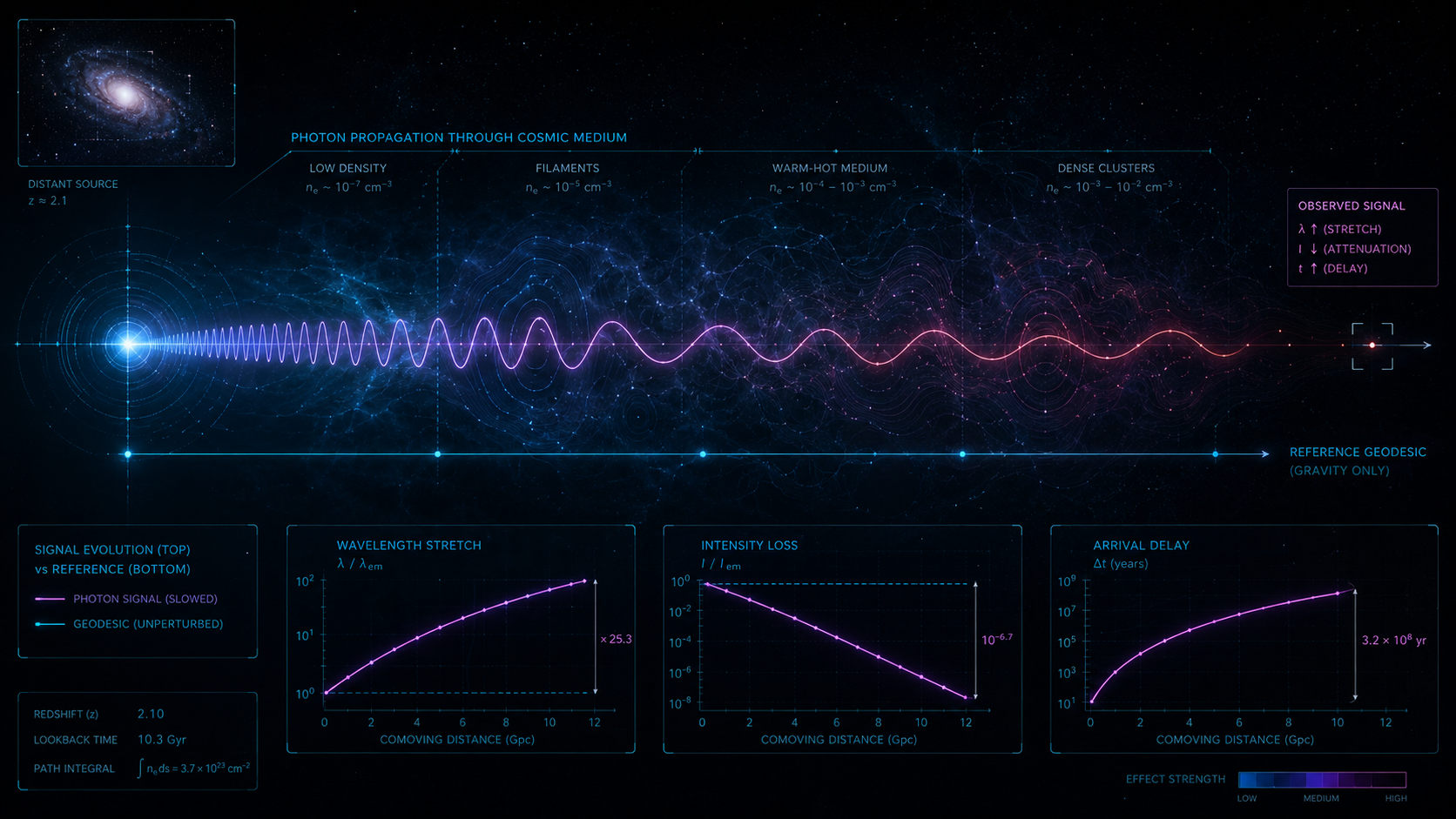
High-redshift Hubble diagrams should show systematic departures if redshift includes light-propagation evolution rather than pure expansion.
Measurable scars
This wing broadens the website from vehicle engineering into the observational tests implied by slow-light, photon-mass, and tired-light cosmological models.
Observable tests
A strong theory should make measurable predictions instead of only offering alternate explanations.
High-redshift Hubble diagrams should show systematic departures if redshift includes light-propagation evolution rather than pure expansion.
Luminosity distance and angular diameter distance may fail the standard relationship if photon propagation changes across cosmic time.
The Tolman brightness scaling becomes a diagnostic for whether distant galaxies are evolving or whether the optical rules are changing.
Supernovae, quasars, and fast radio bursts should reveal whether time-stretching follows exactly standard cosmology or a modified slow-light signature.
If light speed or photon properties vary, lensing maps may disagree with mass maps derived from other methods.
Atomic clocks, long-baseline interferometers, and slow-light cavities can search for tiny accumulated frequency and phase changes.
Instrumentation
The atlas remains speculative, but this section connects the architecture to real classes of precision measurement: timing, phase, frequency, and light-propagation tests.
Electromagnetically induced transparency, atom interferometry, unbalanced Mach-Zehnder interferometry, and slow-light augmented Fabry-Perot cavities all amplify phase sensitivity. Within the Dark Matter Drive narrative, these ideas become the ancestors of the intake and reactor systems.