
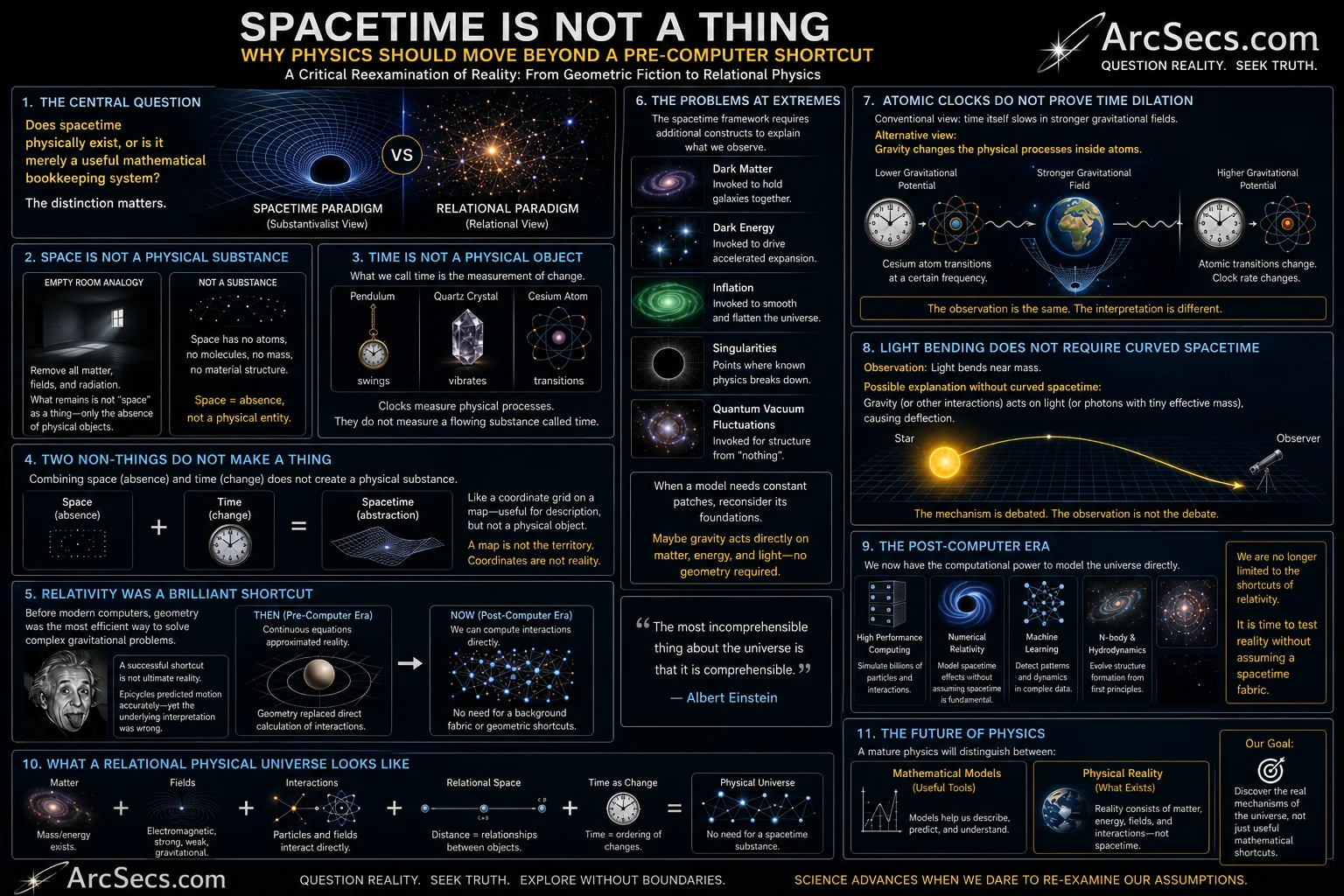
Space is not a physical fabric
This atlas avoids describing the ship as bending space, warping spacetime, riding a metric bubble, or folding a manifold. The craft moves through a static relational void in the project model.
Foundational axioms
This expanded page explains the speculative rule-set behind Dark Matter Drive: no physical spacetime fabric, motion as relational geometry, invariant mass language, tired-light dark matter, photon-mass framing, relational inertia, evidence boundaries, counterarguments, and source links.
Direct answer
The framework is a project hypothesis, not a replacement for accepted physics. This page makes the argument chain visible so readers can evaluate it instead of taking the visuals as proof.
Dark Matter Drive treats motion, inertia, gravity, and propulsion as relationships between physical bodies rather than as motion through a material spacetime substance. The site then asks what a spacecraft, ramscoop, and propulsion model would look like if that assumption were used consistently.
The framework is deliberately labeled as site hypothesis and site-authored conceptual work. Established science is used as background and contrast, while the Dark Matter Drive-specific claims still need validation.
Framework axioms
These axioms are treated as internal rules for the atlas so the visual language, simulator pages, schematics, and propulsion narrative stay consistent.
This atlas avoids describing the ship as bending space, warping spacetime, riding a metric bubble, or folding a manifold. The craft moves through a static relational void in the project model.
Velocity is a relationship between bodies, clocks, fields, and observers. Navigation is therefore framed as relational geometry rather than geodesic surfing.
The page avoids infinite-mass storytelling. The engineering barrier becomes thrust, impact survival, field coupling, and relational inertia management.
Within this project hypothesis, the fuel substrate is modeled as ancient, massive, low-energy photon condensate: optically invisible but gravitationally relevant.
The framework keeps gravity tied to mass-energy relationships and observable deflection rather than describing it as a mysterious independent substance.
The simulator and schematics are explanatory tools. They can clarify a hypothesis, but they do not validate the underlying mechanism by themselves.
Supporting argument chain
The strongest version of the page is not “spacetime is wrong.” It is a transparent chain of motivations, analogies, and open questions.
The site’s relational approach starts with what is observed: relative position, motion, redshift, lensing, acceleration, clock comparison, and energy exchange. It then treats geometric language as a model for organizing those observations rather than as a requirement that space itself be a physical material.
Trust boundary: this is philosophical and modeling language. It does not overturn the predictive success of general relativity.
Gravitational lensing, galaxy rotation anomalies, dark-matter inference, and photon-mass constraints are real scientific topics. The site-specific leap is connecting those topics to a tired-light/dark-matter propulsion substrate. That leap must stay labeled as hypothesis.
Trust boundary: dark matter evidence does not automatically support Dark Matter Drive propulsion.
A strong concept page should list objections instead of hiding them: tired-light models struggle against modern cosmological observations; photon mass is tightly constrained; “no spacetime” language must still reproduce tested gravitational predictions if it wants to compete scientifically.
Trust boundary: a good speculative framework should expose the tests that could defeat it.
The page now separates background, project hypothesis, visual simulation, speculative engineering, and needs-validation claims. That makes it possible to build better simulations, compare predictions, and improve the Research Library without pretending every idea has the same confidence level.
Trust boundary: transparent labels are part of the content, not legal fine print.
Relational inertia
The drive does not use a single gravity nozzle. Its nodal structures alter the vessel relationship to distant cosmic mass shells in the project model.
In the source framework, inertia is not merely a local property locked inside the hull. It is the emergent result of the ship relationship to the surrounding distribution of matter. That is why inertial manipulation nodes are distributed across the midsection and aft flanks.
The visual consequence is not clean glow. It is a failure of optical stability: blurred edges, chromatic fringing, shimmering silhouettes, and observation-induced disorientation. That visual language helps communicate that the ship is changing relationships, not just pushing harder through a medium.
Read the Ghost Ship Effect page for the visual consequences, or open Navigation for the route-planning consequences.
Evidence intersections
This section adds supporting context without overstating what it proves. Each topic links to the site trust layer and to external reading.
Lensing is a strong background topic because it shows light paths responding to mass distributions. The site uses lensing as motivation for asking how mass, light, gravity, and observation should be represented visually.
Claim status: established background when discussing lensing itself; site hypothesis when using it to motivate Dark Matter Drive mechanics.
Rotation curves, lensing, cosmic structure, and cluster observations motivate dark-matter research. The site’s tired-light substrate is not established by those observations; it is a speculative interpretation layered on top of a real unresolved problem.
Claim status: established background for the astrophysical problem; needs validation for the site’s substrate interpretation.
Photon-mass language must be handled carefully because mainstream physics constrains the photon mass very tightly. The page therefore treats massive-photon exhaust as a project hypothesis, not as accepted particle physics.
Claim status: needs validation.
The site’s simulations are best understood as visualization scaffolds. They can make a conceptual model easier to inspect, but they need measurements, equations, and reproducible predictions before they become evidence.
Claim status: visual simulation.
Counterarguments and failure tests
A speculative page is more credible when it says what could prove it wrong or force a rewrite.
Any no-spacetime relational model must reproduce the successful predictions of relativity in tested regimes: lensing, time dilation measurements, orbital dynamics, gravitational waves, and precision cosmology.
Simple tired-light explanations struggle with modern observations such as supernova light curves, the cosmic microwave background, and large-scale structure. The site should not pretend those objections are solved.
Massive-photon language needs a careful mathematical model that respects existing experimental limits and explains where the site model differs from ordinary photon-mass claims.
If the simulator never produces falsifiable outputs, it remains a visualization tool. The roadmap should move toward explicit predictions and comparison metrics.
Supporting source links
External links are provided for background and contrast. They do not certify the site hypothesis.
Historical and technical context for the theory the relational framework is contrasting with.
Dark matter and lensing The dark matter of gravitational lensingA review-style source explaining why lensing is important to dark matter inference.
Weak lensing evidence Cosmic shear and dark matter distributionBackground on weak lensing as a way to map large-scale matter distribution.
Particle constraints Particle Data Group review bookletUse particle-data constraints as a reality check for photon-mass and field-language claims.
Internal trust layer Claim StatusSee how the site separates background, hypothesis, visual simulation, and validation gaps.
Internal evidence layer Evidence MapConnect repeated concepts to claim status, source type, validation state, and related pages.
Internal source-quality layer Source Evaluation MatrixRank supporting material so site-authored concepts are not confused with independent validation.
Internal corpus Research LibraryBrowse the site’s reports, machine-readable metadata, and status labels.
Read next
These internal links turn the relational-physics page into a stronger hub instead of a dead-end concept page.
A DarkMatterDrive dossier on photon mass, direct gravitational force on light, atomic clock behavior, tired-light claims, Proca electrodynamics, and the no-spacetime interpretation of lensing and redshift.
Negative light speedA Dark Matter Drive inspection page for negative light-speed regions, photonic deceleration, gravitational capture, phase-conjugate light behavior, and tired-light dark condensate formation.
Spacetime reimaginedThe ArcSecs no-spacetime foundation for the Dark Matter Drive: space as relational distance, time as measured change, gravity as direct interaction, and spacetime as mathematical map rather than substance.
Dark-sector metrologyA DarkMatterDrive metrology page connecting dark-matter detection gaps, slow-light analogs, quantum interferometry, redshift residuals, lensing anomalies, and precision instruments to the ArcSecs test program.
Propulsion pipelineA step-by-step Dark Matter Drive propulsion breakdown: tired-light dark matter ingestion, intake compression, inverted BEC trapping, SLAFPC storage, cyclotron re-energization, and massive photon exhaust.
Real-science foundationsA public bridge between the speculative Dark Matter Drive and real science: EIT, slow light, BECs, Fabry-Perot cavities, relativistic optics, radiation hazards, Bussard ramjets, Mach principle, and Proca electrodynamics.