
Direct detection gaps
Persistent null results in conventional dark-matter searches motivate alternatives, but they do not automatically prove tired-light dark matter.
Measurement program
The research notes add a measurement spine for DarkMatterDrive: WIMP null results, slow-light analogs, quantum interferometry, atomic clocks, lensing residuals, and space metrology all become pressure tests for the dark-sector thesis.
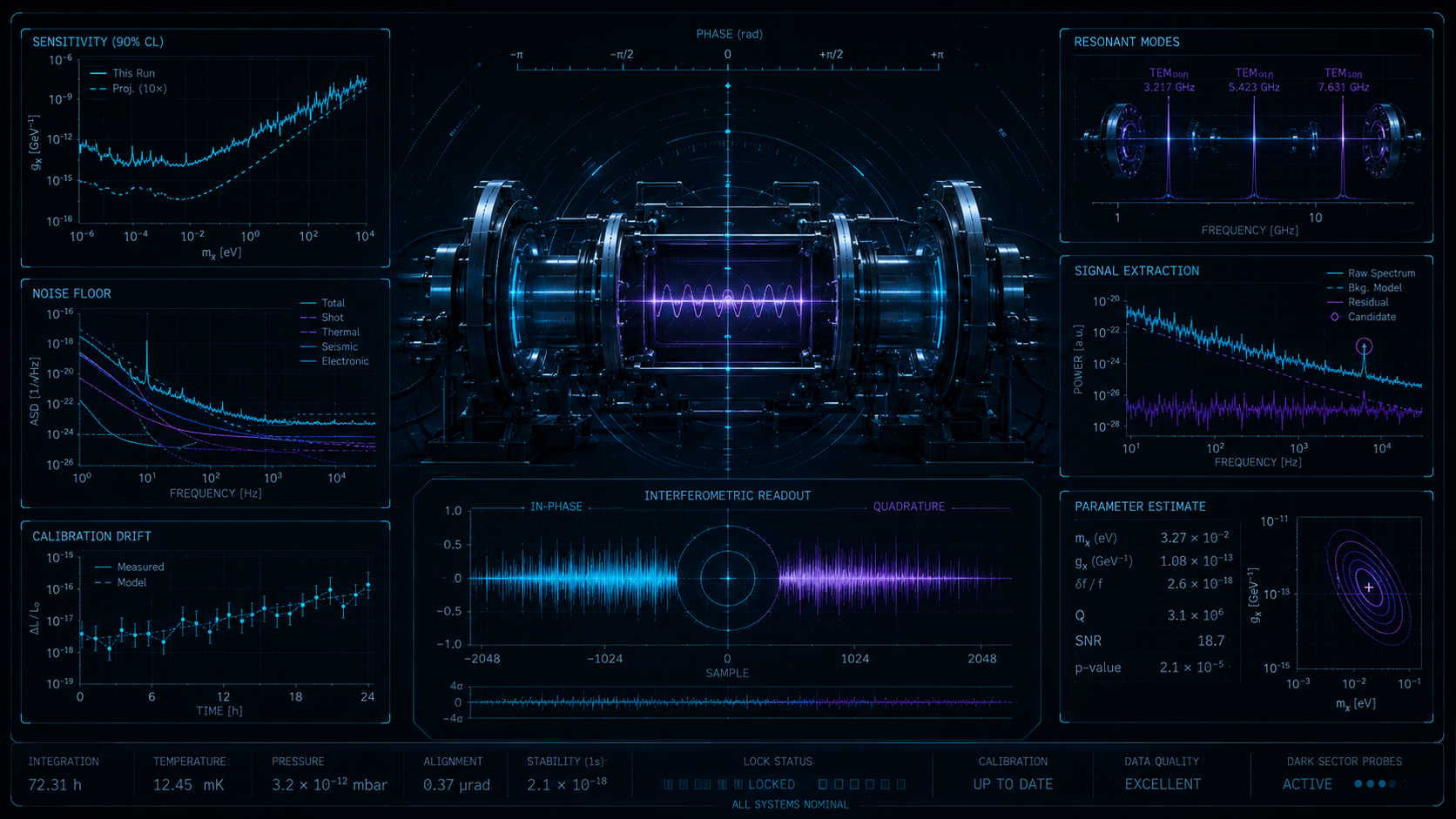
Instrument stack
The page does not claim that the ArcSecs model has been verified. It names the instrument classes and observations that would make the model harder to fake.
Persistent null results in conventional dark-matter searches motivate alternatives, but they do not automatically prove tired-light dark matter.
Atom interferometers and precision clocks are the right class of instruments for phase, acceleration, and tiny coupling tests.
Lensing, redshift drift, distance duality, FRB dispersion, and time-delay data decide whether the story survives outside the schematic.
Test matrix
Each speculative claim gets paired with the kind of observation that could constrain it.
| Claim area | Observable handle | Useful instrument class |
|---|---|---|
| Slow or tired light | Frequency-dependent time delay, redshift drift, distance residuals | Spectrographs, transient surveys, precision timing |
| Photon mass effects | Dispersion, lensing anomalies, magnetic-field constraints | Radio astronomy, interferometry, magnetometry |
| Relational inertia | Acceleration anomalies and gravitational-gradient response | Atom interferometers and deep-space tracking |
| Dark condensate fuel | Density gradients, lensing residuals, local coupling signals | Weak-lensing maps, cold sensors, space metrology |