
Invisible mass evidence
Bullet Cluster, MACS J0025, galaxy rotation curves, Planck cosmology, and weak lensing support the reality of unseen mass problems. They do not prove the drive.
Scientific source map
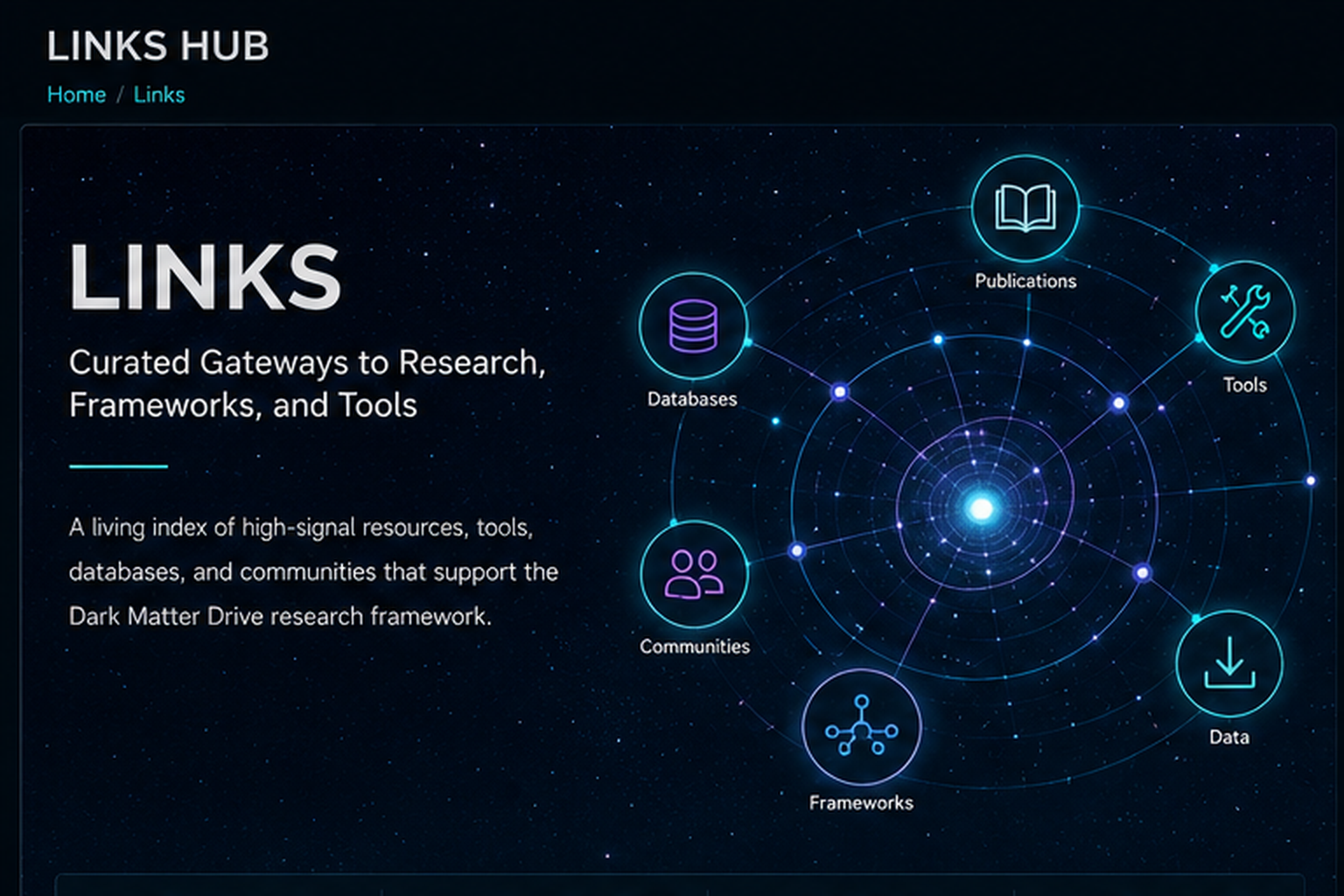
A greatly expanded scientific link library for Dark Matter Drive. The page separates mainstream physics baselines, evidence that supports invisible mass and controllable light, theoretical analogs that support the site viewpoint, pressure tests that challenge the model, and internal trust-boundary routes.
Direct answer
These links are selected to support, constrain, or challenge the Dark Matter Drive viewpoint without pretending that site-authored speculation is already proven science.
This is the scientific support map for Dark Matter Drive. It now emphasizes peer-reviewed papers, official science sources, review articles, metrology projects, navigation references, and internal trust-boundary pages.
The strongest links support background pillars: invisible mass is a real inference problem, light paths can reveal mass distribution, EIT and slow-light effects are real in media, photon condensates/effective photon mass exist in constrained systems, Machian inertia has a serious literature, and spacecraft navigation depends on disciplined ephemerides, astrometry, and timing. The speculative leap is connecting those pillars into the Dark Matter Drive architecture.
83 links are grouped below by scientific role and claim boundary.
Machine-readable source library
The same scientific source map is exposed as cached JSON so future pages, tests, and AI tooling can reuse the long-term source memory.
Open scientific-source-library.json
This JSON endpoint includes source groups, relation notes, claim-status labels, source-quality labels, duplicate-url flags, and machine-readable support tags.
Scientific support map
This map shows why the source groups matter before the full source-card library.
Bullet Cluster, MACS J0025, galaxy rotation curves, Planck cosmology, and weak lensing support the reality of unseen mass problems. They do not prove the drive.
General relativity, Hubble lensing, weak lensing, interferometry, and precision clocks show that light, gravity, time, and measurement are deeply connected.
EIT, slow light, stored light, photon BECs, and optical cavities support the site use of quantum-optical analogies while remaining lab-scale phenomena.
Machian and relational dynamics papers provide a serious conceptual neighborhood for the site no-material-spacetime language.
JPL Horizons, DSN, IAU SOFA, Gaia, and pulsar-navigation research keep the navigation page grounded in real precision navigation culture.
Photon-mass limits, Tolman tests, LCDM baselines, and tired-light objections keep the site honest about what still needs validation.
Reference links
Each card gives the source, the reason it belongs here, and the part of the Dark Matter Drive framework it touches.
6 sources in this group
ArcSecs.com is the sister article site for the broader physics essays. DarkMatterDrive points to those posts while keeping this site centered on the vehicle atlas, schematics, and curated source map.
The Dark Matter Drive: Why Warp Bubbles May Be Propulsion Wakes, Not Bent Spacetime https://arcsecs.com/dark-matter-drive-reinterprets-warp-bubbles/This is the live ArcSecs post for the Dark Matter Ramjet mass-flow reinterpretation that informs the DarkMatterDrive ramjet and propulsion pages.
If Light Slows Across the Cosmos, What Would We Actually Measure? https://arcsecs.com/if-light-slows-across-the-cosmos-what-would-we-measur/This is the live ArcSecs metrology post for observable slow-light signatures such as redshift drift, lensing anomalies, time-delay stretching, and photon-mass constraints.
Navigating the Dark Sector: Slow Light, Quantum Interferometry, and Space Metrology https://arcsecs.com/navigating-the-dark-sector-slow-light-quantum-interferometry-space-metrology-2/This live ArcSecs post anchors the DarkMatterDrive dark-sector metrology page and its measurement-stack language.
Lost Light in an Expanding Universe: Where Does Redshifted Energy Go? https://arcsecs.com/lost-light-in-an-expanding-universe/This live ArcSecs post anchors the lost-light cosmology page and the distinction between lost visibility, redshifted energy, and gravitational accounting.
Do Photons Have Mass? Rethinking Gravity, Light, and Atomic Time https://arcsecs.com/do-photons-have-mass-rethinking-gravity-light-atomic-time/This live ArcSecs post anchors the photon-mass and gravity dossier around direct light-gravity interaction and atomic-clock interpretation.
3 sources in this group
This is the standard geometric starting point: contraction ahead, expansion behind, and a locally flat region around the craft. ArcSecs uses it as the contrast case for the mass-flow interpretation.
Finazzi, Liberati, Barcelo - Semiclassical Instability of Dynamical Warp Drives https://arxiv.org/abs/0904.0141This is the instability pressure point. It frames why ArcSecs avoids literal spacetime bubbles and treats the observed bubble as a physical wake instead.
McMonigal, Lewis, OByrne - The Alcubierre Warp Drive: On the Matter of Matter https://arxiv.org/abs/1202.5708This connects to particle accumulation and destination-burst concerns. ArcSecs shifts the hazard from metric debris capture to an engine-wake and shielding problem.
3 sources in this group
This gives the mainstream baseline: mass bends observed light paths. ArcSecs keeps the observation but disputes that it proves a material spacetime fabric.
SuperCDMS SNOLAB https://supercdms.slac.stanford.edu/This represents real dark-matter detection work. ArcSecs uses it as a reality check because any tired-light dark sector would eventually need experimental contact.
MAGIS-100 Atom Interferometer https://magis.fnal.gov/This connects the website to precision metrology: atom interferometers are the type of instrument class ArcSecs points toward for tiny phase, acceleration, and dark-sector coupling tests.
6 sources in this group
This gives the conventional constraint environment around photon mass. ArcSecs depends on the idea that experimental bounds are not the same thing as proving exact zero.
Dispersive Interaction Between Two Atoms in Proca Quantum Electrodynamics https://arxiv.org/pdf/2406.06862This provides a modern Proca-QED anchor for thinking about a photon mass term, longitudinal polarization behavior, and field-theory changes when electromagnetism is not strictly Maxwellian.
Goldhaber and Nieto - Photon and Graviton Mass Limits https://arxiv.org/abs/0809.1003High-value review for photon-mass and graviton-mass constraints. It supports the site insistence that massive-photon language must live inside a strict constraint environment.
Photon-mass constraint map Peer-reviewed review / preprint Established background Tu, Luo, and Gillies - The Mass of the Photon https://arxiv.org/abs/physics/0501140Broad review of photon-mass limits and measurement logic. It supports the links page as a constraint-aware scientific map rather than a one-sided claim sheet.
Photon-mass constraints Peer-reviewed review / preprint Established background Particle Data Group Review of Particle Physics https://pdg.lbl.gov/Authoritative particle-physics reference hub. Use this as a reality check for any photon-mass, particle, field, or constraint claim.
Constraint authority Primary official reference Established background Proca Quantum Electrodynamics and Atomic Dispersion https://arxiv.org/abs/2406.06862Modern Proca-QED example for how adding a photon mass term changes electromagnetic interaction modeling. Useful for the site Proca language, but still not drive validation.
Proca modeling context Recent scholarly preprint Conceptual support2 sources in this group
This is the experimental slow-light anchor behind the EIT-ramscoop analogy: group velocity can be radically altered under controlled quantum-optical conditions.
Klaers et al. - Bose-Einstein Condensation of Photons in an Optical Microcavity https://arxiv.org/abs/1007.4088This supports the photon-BEC analogy used by the SLAFPC/BEC trap sections. ArcSecs scales the concept speculatively into dark-sector storage.
2 sources in this group
This is the conventional ramjet comparison. ArcSecs keeps the idea of collecting reaction mass but replaces sparse hydrogen with a tired-light dark substrate.
A. A. Jackson - Three Interstellar Ram Jets http://large.stanford.edu/courses/2021/ph241/mccullough1/docs/jackson-2016.pdfThis provides technical context for why ramjet drag, field size, and capture geometry matter so much in the Dark Matter Drive architecture.
6 sources in this group
This relates to the website sections that treat light speed as a local or cosmological variable rather than an absolute kinematic wall.
Tolman Surface Brightness Test https://en.wikipedia.org/wiki/Tolman_surface_brightness_testThis is one of the major observational challenges any tired-light or slow-light cosmology must address, so it belongs on the links page as a falsifiability checkpoint.
Magueijo - New Varying Speed of Light Theories https://arxiv.org/abs/astro-ph/0305457Review of VSL mechanisms and observational status. It supports the site decision to discuss variable-light ideas as serious theoretical speculation with constraints.
VSL literature context Peer-reviewed review / preprint Conceptual support / needs validation Albrecht and Magueijo - Time Varying Speed of Light as a Solution to Cosmological Puzzles https://arxiv.org/abs/astro-ph/9811018Classic VSL cosmology paper. It supports the links page by showing that variable-light cosmology has appeared in formal literature, even though Dark Matter Drive uses a different site hypothesis.
VSL cosmology precedent Primary peer-reviewed preprint Conceptual support / needs validation Zwicky - On the Red Shift of Spectral Lines Through Interstellar Space https://ui.adsabs.harvard.edu/abs/1929PNAS...15..773Z/abstractHistorical origin point for tired-light thinking. It belongs here as a historical anchor, not as modern validation.
Historical tired-light context Primary historical source Historical / pressure test Lubin and Sandage - Tolman Surface Brightness Test https://arxiv.org/abs/astro-ph/0106566Important observational pressure test against simple tired-light cosmologies. The links page includes it because serious support requires visible falsifiability checkpoints.
Falsifiability checkpoint Peer-reviewed preprint Pressure test1 sources in this group
9 sources in this group
This source lays out the umbrella Dark Matter Drive argument: no spacetime fabric, tired-light dark matter, relational inertia, and massive-photon exhaust.
The ArcSecs Dark Matter Drive Detailed Description https://darkmatterdrive.com/wp-content/themes/darkmatterdrive-theme/assets/docs/detailed-drive-description.pdfThis source describes the physical architecture: ablative shield, Fishback solenoid, luminous bow shock, optical vortex, inertial nodes, and aft photon aperture.
Advanced Theoretical and Applied Physics in Relativistic Aerospace Architectures https://darkmatterdrive.com/wp-content/themes/darkmatterdrive-theme/assets/docs/advanced-theoretical-and-applied-physics-in-relativistic-aerospace-architectures.pdfThis source connects the speculative architecture to real physics ingredients: EIT, photon BECs, Fabry-Perot cavities, Fishback limits, shielding, and Proca massive photons.
Physics TDD: Massive Photons, Not Spacetime https://darkmatterdrive.com/wp-content/themes/darkmatterdrive-theme/assets/docs/physics-tdd-massive-photons-not-spacetime.pdfThis PDF backs the massive-photon and no-spacetime language used across the physics, propulsion, and photon-gravity pages. It is linked as a PDF only, not as an editable Markdown file.
Measuring Slow-Light Cosmology Effects https://darkmatterdrive.com/wp-content/themes/darkmatterdrive-theme/assets/docs/measuring-slow-light-cosmology-effects.pdfThis PDF supports the testing language around redshift residuals, time-delay stretching, distance duality, lensing mass-bias, FRB dispersion, and precision metrology.
No Universal Speed Limit Theory https://darkmatterdrive.com/wp-content/themes/darkmatterdrive-theme/assets/docs/no-universal-speed-limit-theory.pdfThis PDF anchors the relational-motion and systems-architecture argument that the speed of light is treated as a local interaction bandwidth rather than a universal motion ceiling.
Dark Matter With Slow Light https://darkmatterdrive.com/wp-content/themes/darkmatterdrive-theme/assets/docs/dark-matter-with-slow-light.pdfThis PDF supports the slow-light dark-matter estimate by showing how tired-light distance recalibration can make the observable universe more compact and reduce the inferred amount of dark matter required.
Dark Matter Drive Scarcity Solutions https://darkmatterdrive.com/wp-content/themes/darkmatterdrive-theme/assets/docs/dark-matter-drive-scarcity-solutions.pdfThis PDF connects the Dark Matter Drive resource thesis to interstellar ramjet scarcity problems, dark-sector reaction mass, and why ambient fuel collection matters for long-range transit.
Lost Light in an Expanding Universe https://darkmatterdrive.com/wp-content/themes/darkmatterdrive-theme/assets/docs/lost-light-in-expanding-universe.pdfThis PDF gives the conventional cosmology counterpoint on redshift, FLRW expansion, horizons, and energy accounting, so the site does not present the ArcSecs model without the mainstream baseline.
4 sources in this group
Historical primary baseline for the geometric theory Dark Matter Drive is contrasting with. The site uses this as the mainstream reference point before arguing for a no-material-spacetime interpretation.
Baseline contrast Primary historical / scholarly review Established background NASA Hubble - Gravitational Lenses https://science.nasa.gov/mission/hubble/science/science-behind-the-discoveries/hubble-gravitational-lenses/Clear mainstream explanation that mass changes observed light paths. This supports the site focus on light-path evidence while the site disputes whether that requires treating spacetime as a material substance.
Light-path evidence Primary official source Established background Weak Gravitational Lensing by Large-Scale Structure https://arxiv.org/abs/astro-ph/0307212A review anchor for weak lensing as a mass-mapping method. Useful for the site argument that lensing is an observational handle on invisible mass distributions.
Mass mapping Peer-reviewed review / preprint Established background Cosmic Shear and Weak Lensing Detection https://arxiv.org/abs/astro-ph/0003014Background for using small statistical distortions of galaxy images to infer mass distribution. This supports the Dark Matter Drive emphasis on indirect field measurement.
Indirect field measurement Peer-reviewed preprint Established background5 sources in this group
Bullet Cluster weak-lensing evidence is a major support for unseen mass separate from hot baryonic gas. It supports the site emphasis on invisible mass distribution while not proving the drive mechanism.
Invisible mass distribution Peer-reviewed preprint Established background NASA / Chandra - Bullet Cluster Direct Proof of Dark Matter https://chandra.harvard.edu/press/06_releases/press_082106.htmlOfficial public-facing science communication for the Bullet Cluster result. It gives non-specialists a readable version of the lensing/gas separation argument.
Public dark-matter evidence Primary official source Established background Planck 2018 Cosmological Parameters https://arxiv.org/abs/1807.06209Cosmic microwave background parameter baseline for modern LCDM cosmology. This provides the mainstream density-accounting context the site must compare against honestly.
Cosmology baseline Primary collaboration paper Established background MACS J0025.4-1222 Dark Matter Separation https://arxiv.org/abs/0806.2320Another cluster-collision lensing case where mass and baryonic plasma are compared. Useful as a second unseen-mass anchor beyond the Bullet Cluster.
Independent lensing evidence Peer-reviewed preprint Established background Rubin, Ford, and Thonnard - Rotational Properties of 21 Sc Galaxies https://ui.adsabs.harvard.edu/abs/1980ApJ...238..471R/abstractClassic rotation-curve evidence for missing mass. This supports the site claim that invisible mass is not a fringe problem, even though it does not validate tired-light dark matter.
Galaxy rotation evidence Primary peer-reviewed source Established background4 sources in this group
Modern discussion of Machian inertia ideas inside relativistic physics. This supports the site language that inertia can be discussed relationally, while keeping the site model distinct.
Relational inertia framing Scholarly preprint Established background / conceptual support Putz - A Theory of Inertia Based on Machs Principle https://arxiv.org/abs/1808.06687A concrete attempt to formulate inertia through Machian ideas. Useful as supporting literature for the site focus on distant mass relationships and inertia.
Machian inertia model Scholarly preprint Conceptual support / needs validation Norton - Machs Principle https://sites.pitt.edu/~jdnorton/papers/MachPrinciple.pdfHistorical and philosophical review of Machs principle. This helps readers understand why relational inertia is a serious old question, not a made-up web slogan.
Historical relational framing Scholarly review Established background / conceptual support Barbour and Bertotti - Machs Principle and the Structure of Dynamical Theories https://royalsocietypublishing.org/doi/10.1098/rspa.1982.0082Foundational relational-dynamics reference. It supports the broader idea that dynamics can be formulated with relational structure, even if the Dark Matter Drive model remains speculative.
Relational dynamics Primary peer-reviewed source Conceptual support4 sources in this group
Reviews EIT in coherent optical media. This is a high-value scientific foundation for the macroscopic EIT ramscoop analogy, with the trust boundary that laboratory EIT is not a spacecraft engine.
EIT foundation Peer-reviewed review Established background Hau et al. - Light Speed Reduction to 17 Metres per Second https://www.nature.com/articles/17561Demonstrates extreme slow-light behavior in ultracold atomic gas. It supports the site analogy that optical propagation can be dramatically changed by media, not the claim that vacuum c is bypassed.
Slow-light experiment Primary peer-reviewed source Established background Phillips et al. - Storage of Light in Atomic Vapor https://arxiv.org/abs/quant-ph/0105103Useful support for the site language around halted/stored light and quantum optical memory analogies.
Stored-light analogy Primary peer-reviewed preprint Established background Budker et al. - Nonlinear Magneto-optics and Slow Light https://arxiv.org/abs/physics/0204035Supports the broader idea that coherent media can produce unusual optical propagation and precision measurement effects.
Precision optical media Scholarly preprint Established background3 sources in this group
This is one of the strongest analog sources for the sites photon-condensate language because the cavity gives photons an effective mass and supports photon BEC behavior.
Photon BEC analogy Primary peer-reviewed preprint Established background / analogy Klaers et al. - Photon BEC Toward Photonic Lattices and Coupled Cavities https://arxiv.org/abs/1303.5772Extends the photon-BEC context toward structured photonic systems. Useful for the site language around containment, cavity behavior, and condensate analogs.
Structured photon condensates Scholarly preprint Conceptual support Figuiredo, Tercas, and Mendonca - Photon BEC in Microcavity Plasmas https://arxiv.org/abs/2211.15857Recent theoretical source where microcavity plasma conditions induce finite photon mass and condensation behavior. This is useful context for exotic photon-state analogies.
Finite effective photon mass analogy Recent scholarly preprint Conceptual support4 sources in this group
Official project page for long-baseline atom interferometry. It supports the site metrology theme: tiny phase shifts, acceleration, and potential dark-sector tests need instruments, not vibes.
Precision metrology Primary official source Established background MAGIS-100 Science Case https://arxiv.org/abs/2104.02835Scientific context for atom interferometer searches and precision physics. Useful support for Dark Matter Drive dark-sector metrology pages.
Dark-sector metrology Scholarly preprint Established background / conceptual support LIGO - What Are Gravitational Waves? https://www.ligo.caltech.edu/page/what-are-gwOfficial background on precision interferometric detection of tiny strain signals. It supports the site message that deep physics claims require extraordinary metrology.
Interferometric measurement culture Primary official source Established background NIST Optical Atomic Clocks https://www.nist.gov/programs-projects/optical-atomic-clocksOfficial background for clock precision and metrology. It supports the site emphasis on timing references, redshift tests, and navigation discipline.
Timing and clock metrology Primary official source Established background3 sources in this group
Historical origin point for the ramjet idea: collect reaction mass from the environment. Dark Matter Drive reuses the collection logic but replaces the medium with a speculative dark-sector substrate.
Ambient reaction-mass collection Primary historical source Established background / analogy Fishback - Relativistic Interstellar Spaceflight https://ui.adsabs.harvard.edu/abs/1969AcAau...15...25F/abstractClassic magnetic-scoop/field-stress constraint reference. It supports the site emphasis on field geometry, stress limits, and collection hazards.
Ramjet field constraints Primary peer-reviewed source Established background / analogy Zubrin and Andrews - Magnetic Sails and Interstellar Travel https://ui.adsabs.harvard.edu/abs/1991JBIS...44..489Z/abstractMagnetic sail work adds context for using large-scale electromagnetic structures against interstellar plasma. Useful for comparing capture, braking, and field geometry ideas.
Field interaction and braking analog Primary peer-reviewed source Established background / analogy5 sources in this group
Internal page that labels whether claims are established background, site hypothesis, visual simulation, speculative engineering, or needs validation.
Trust boundary Site-authored governance page Site metadata Evidence Map https://darkmatterdrive.com/evidence-map/Internal map connecting concepts to claim status, source type, validation state, and related pages.
Concept-to-evidence mapping Site-authored governance page Site metadata Source Evaluation Matrix https://darkmatterdrive.com/source-evaluation/Internal source-quality matrix that prevents site-authored reports and simulations from being confused with independent validation.
Source-quality ranking Site-authored governance page Site metadata Relational Physics https://darkmatterdrive.com/relational-physics/Internal hub where Machian inertia, no-material-spacetime language, light/gravity background, and counterarguments are organized.
Project hypothesis hub Site-authored explainer Site hypothesis Navigation https://darkmatterdrive.com/navigation/Internal hub connecting ephemerides, astrometry, autonomous timing, sensor fusion, and speculative relational mass geometry.
Navigation concept hub Site-authored explainer Visual simulation / site hypothesis3 sources in this group
Public page tying the uploaded gravitational-wave/light-delay diagrams and reports into the site information architecture.
ArcSecs model explainer Site-authored explainer Site hypothesis / needs validation Physics Engine Decoupled Multi-Messenger Propagation Report https://darkmatterdrive.com/multi-messenger-propagation/#engine-memoryLong-term memory report defining the MultiMessenger Propagation System, PhotonWavefront, GravityWavefront, Proca substrate density sampling, and UI telemetry requirements.
Physics engine implementation memory Site-authored technical report Site hypothesis / implementation note Modeling Light Slowing and Energy Degeneration Report https://darkmatterdrive.com/multi-messenger-propagation/#model-memoryLong-term memory report connecting GW170817, GW150914, GW190521, energy degeneration, intrinsic delay, environmental diffusion, and future O4/O5 pressure tests.
Model calibration and pressure tests Site-authored mathematical report Site hypothesis / needs validation4 sources in this group
Public library PDF for the multi-messenger mathematical model connecting gravitational-wave timing, electromagnetic attenuation, energy degeneration, intrinsic delay, and environmental diffusion.
Multi-messenger propagation model Site-authored PDF report Site hypothesis / needs validation Rethinking Light, Time, and Spacetime PDF https://darkmatterdrive.com/wp-content/themes/darkmatterdrive-theme/assets/docs/rethinking-light-time-and-spacetime.pdfPublic library PDF for the relational-cosmology argument against physical spacetime substantivalism and for light-slowing / energy-degeneration framing.
Relational cosmology framing Site-authored PDF report Site hypothesis / needs validation New Universe Framework: Time and Distance PDF https://darkmatterdrive.com/wp-content/themes/darkmatterdrive-theme/assets/docs/new-universe-framework-time-and-distance.pdfPublic library PDF for the discrete relational framework connecting distance without lightyears, clockless time, decoupled propagation, and dark-sector reinterpretation.
Distance, time, propagation, and dark-sector claim framing Site-authored PDF report Site hypothesis / needs validation ArcSecs Perspective Research Report PDF https://darkmatterdrive.com/wp-content/themes/darkmatterdrive-theme/assets/docs/arcsecs-perspective-research-report.pdfPublic library PDF strengthening the ArcSecs perspective around Teleparallel/TEGR torsion gravity, massive Proca photon electrodynamics, Mass-Polariton momentum transfer, tired-light kinetic degradation, and Dark Matter Drive ramscoop/vortex concepts.
Proca, Teleparallel, relational kinetics, and dark-substrate claim framing Site-authored PDF report Site hypothesis / needs validationReading strategy
The best path is to start with the mainstream references, then compare them against the ArcSecs reinterpretation pages.
Read general relativity, lensing, Planck, dark-matter, ephemeris, and metrology references first so the mainstream baseline is clear.
Use photon-mass limits, Tolman surface brightness, tired-light objections, and source-quality labels as reality checks.
Connect EIT, photon BECs, Proca mass, relational mechanics, ramjets, and dark-sector metrology back to the Dark Matter Drive pages.
Internal trust routes
These internal pages explain how to evaluate source strength and speculative claims.
A transparent claim-status guide explaining which Dark Matter Drive ideas are established background, site hypotheses, visual simulations, speculative engineering concepts, or areas needing validation.
Evidence MapA public evidence map connecting Dark Matter Drive concepts to claim status, source type, validation state, related pages, and machine-readable trust metadata.
Source Evaluation MatrixA transparent source-evaluation matrix explaining how DarkMatterDrive.com ranks peer-reviewed sources, official documentation, site-authored reports, simulations, and speculative claims.
Relational PhysicsA greatly expanded guide to the speculative relational-physics framework behind Dark Matter Drive: no-spacetime assumptions, relational inertia, photon-mass framing, dark-matter background evidence, counterarguments, source links, and trust-boundary labels.
NavigationAn expanded guide to Dark Matter Drive navigation: relational mass geometry, inertial-gradient routing, star-tracker distortion handling, ephemeris discipline, pulsar/autonomous navigation analogies, hazard filtering, failure modes, external source links, and trust-boundary labels.
Research LibraryBrowse the Dark Matter Drive research library: MQN hypothesis reports, dark matter propulsion concepts, simulation notes, compact-fusion documents, citation metadata, and peer-reviewed source tracking.