
EIT scoop field
Changes the optical state of the incoming substrate and separates capture aperture from destructive impact area.
Massive photon propulsion
This page explains the propulsion side of the Dark Matter Drive in plain engineering order: collect tired-light substrate, compress it, trap it, re-energize it, and expel it as a massive-photon exhaust stream. The Dark Matter Ramjet name belongs here because this is the engine cycle.
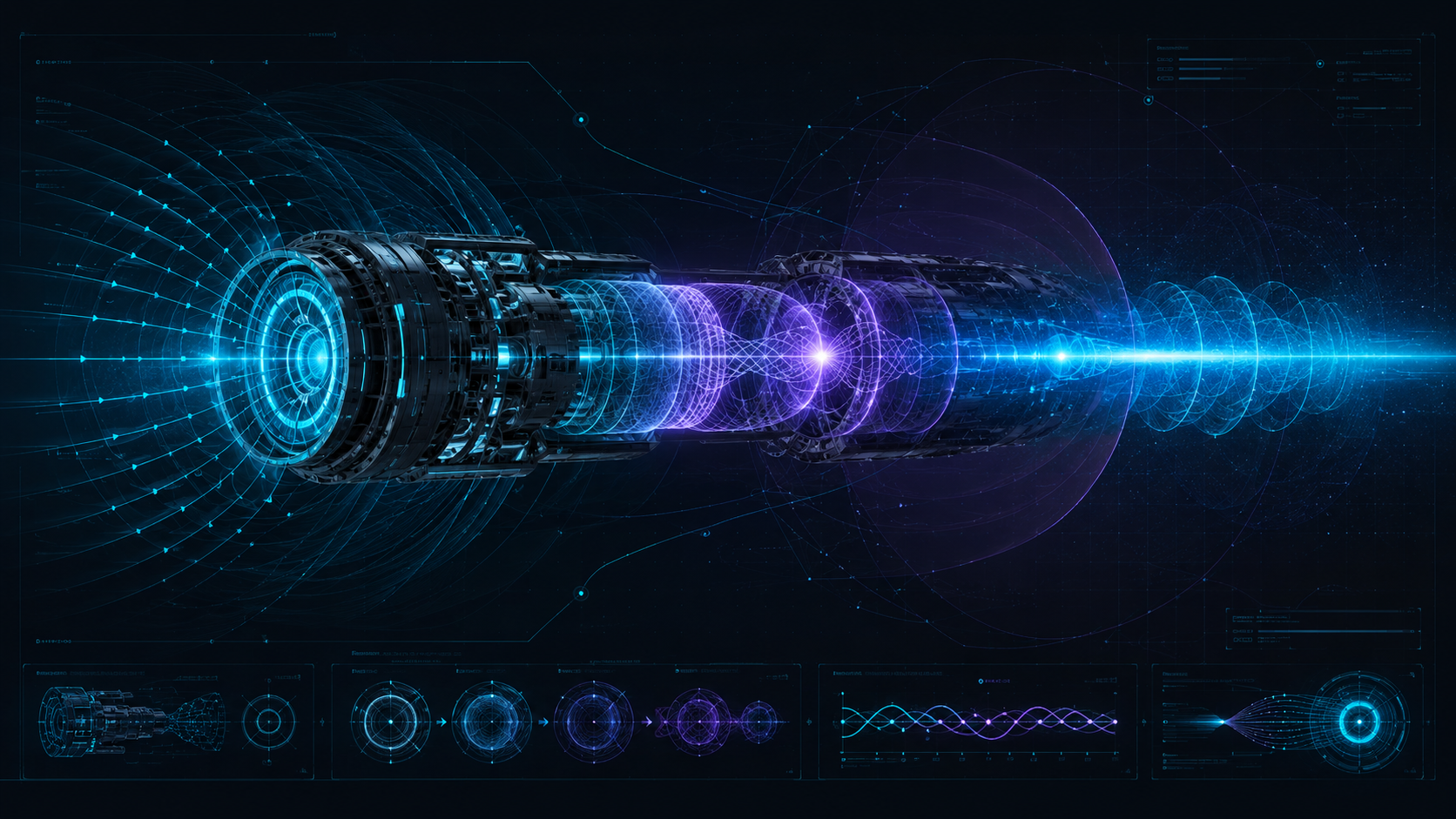
Engine thesis
The propulsion page now begins with the core mechanical distinction. ArcSecs is not describing a normal photon rocket that shines massless light backward. The framework treats the exhaust as re-energized massive photons, so the plume functions as physical reaction mass.
The Dark Matter Drive starts with diffuse, low-energy tired light. In the site vocabulary, that substrate is a massive-photon condensate: optically dark, gravitationally active, and spread through the void. The drive does not carry all propellant onboard. It gathers the substrate through the EIT scoop and turns it into an exhaust stream.
The visual language should therefore read like an accelerator and refinery, not a magic warp nozzle: capture field, compression throat, SLAFPC/BEC trap, cyclotron re-energization, and a collimated aft aperture.
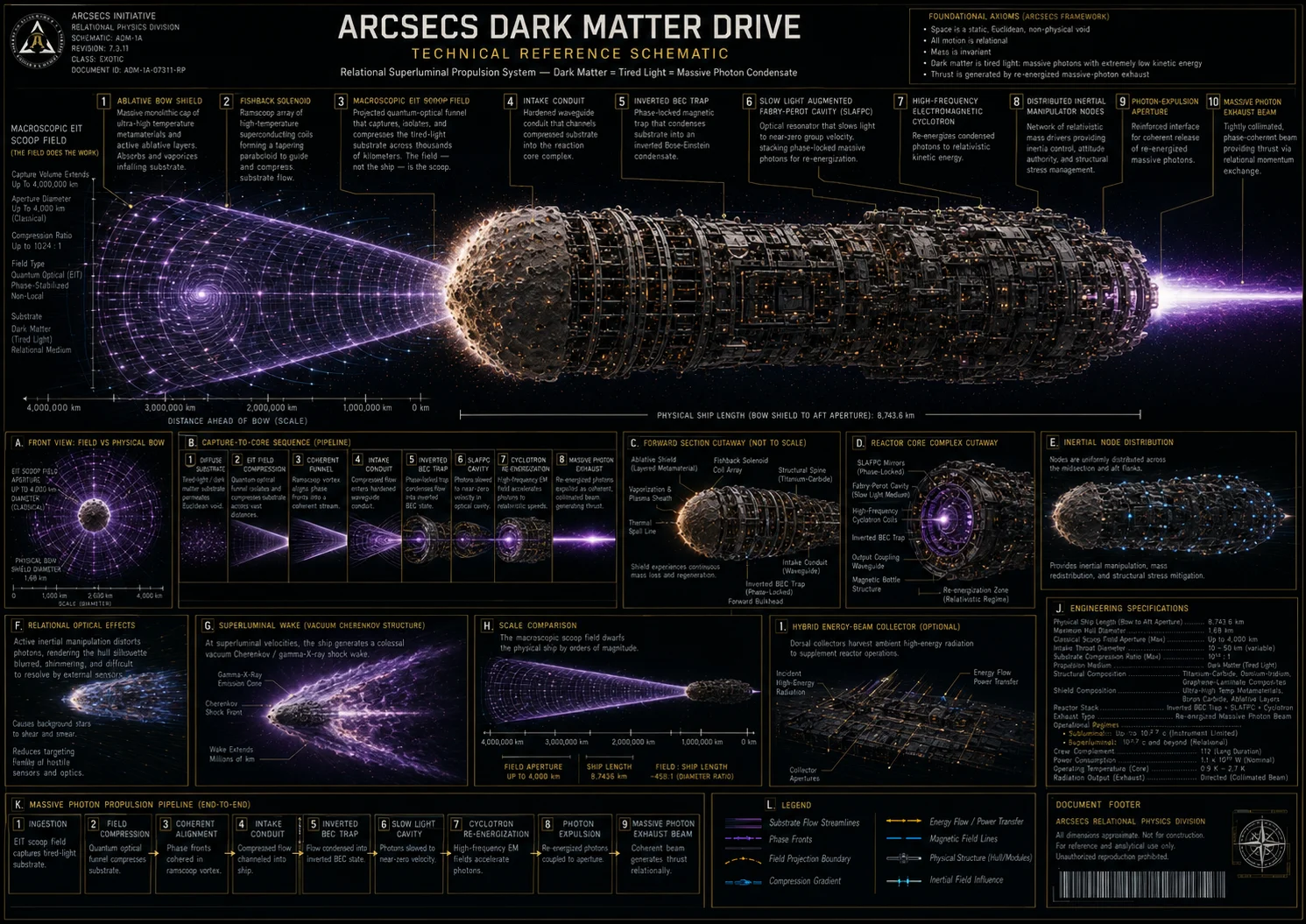
End-to-end flow
This sequence shows where the fuel comes from, how it is compressed, how it is energized, and why the exhaust is not ordinary light.
Projected EIT field gathers tired-light substrate across a field aperture far larger than the physical ship.
Inverted BEC-like cavity captures the massive-photon condensate and prevents random dispersion.
SLAFPC phase-locks, slows, and densifies the flow until it behaves like a usable feedstock.
Cyclotron fields restore kinetic energy to the captured quanta and prepare a coherent exhaust pulse.
Electro-optical vanes and magnetic nozzle geometry focus the output into a narrow aft beam.
Momentum exchange pushes the vessel forward while producing a hazardous gamma/X-ray wake.
Reactor stack
The pipeline works only if each subsystem solves a different physical problem: collection, coherence, density, energy restoration, and vector control.
Changes the optical state of the incoming substrate and separates capture aperture from destructive impact area.
Treats old light as a condensate-like reservoir that can be organized rather than immediately radiated away.
Uses slow-light and Fabry-Perot logic to extend interaction time, increase phase discipline, and compress the feed.
Restores kinetic energy to the massive-photon substrate and reverses the tired-light aging process.
Functions as a beam-forming radiation throat, not a bell-shaped chemical rocket nozzle.
Reduces relational drag and keeps the flow envelope coherent enough that thrust is not cancelled by intake resistance.
Core distinction
The source framework treats the exhausted photons as possessing invariant rest mass. That makes the plume behave like physical exhaust rather than a weak massless photon rocket.
| System | Fuel | Exhaust | Limitation or advantage |
|---|---|---|---|
| Classical photon rocket | Onboard energy | Massless photons | Extremely low thrust per watt. |
| Bussard ramjet | Interstellar hydrogen | Fusion products | Drag can exceed thrust if capture is not solved. |
| Dark Matter Ramjet | Tired-light dark matter | Re-energized massive photons | Uses a ubiquitous substrate and frames the apparent warp shell as mass flow. |
Reference plate
Open the high-resolution plate to review the capture-to-core sequence, reactor module, photon aperture, and massive-photon exhaust beam.