
Ablative bow shield
An opaque monolithic cap of dense ice, structured water, graphene, or carbon metamaterial. It is cratered, chaotic, and constantly luminous from relativistic impacts.
Brutalist engineering leviathan
Every visible feature exists because the vessel must survive relativistic impacts, manipulate relational inertia, compress tired-light substrate, and expel re-energized massive photons without resembling a conventional rocket.

Primary anatomy
The vessel reads as a layered machine: shield, solenoid, intake, reactor, nodal flanks, and aft aperture.
An opaque monolithic cap of dense ice, structured water, graphene, or carbon metamaterial. It is cratered, chaotic, and constantly luminous from relativistic impacts.
A long tapering paraboloid of exposed superconducting coils. Its geometry follows magnetic field architecture rather than streamlining.
A narrow, shielded throat behind the bow that accepts the compressed massive-photon flow after field capture.
The onboard sequence of inverted BEC trap, SLAFPC compression, cyclotron acceleration, and output coupling.
Geometric nodal systems distributed across the midsection and aft flanks, producing edge blur and field interference when active.
A reinforced metamaterial-lined aperture, not a flared nozzle. It emits a tightly collimated beam of re-energized massive photons.
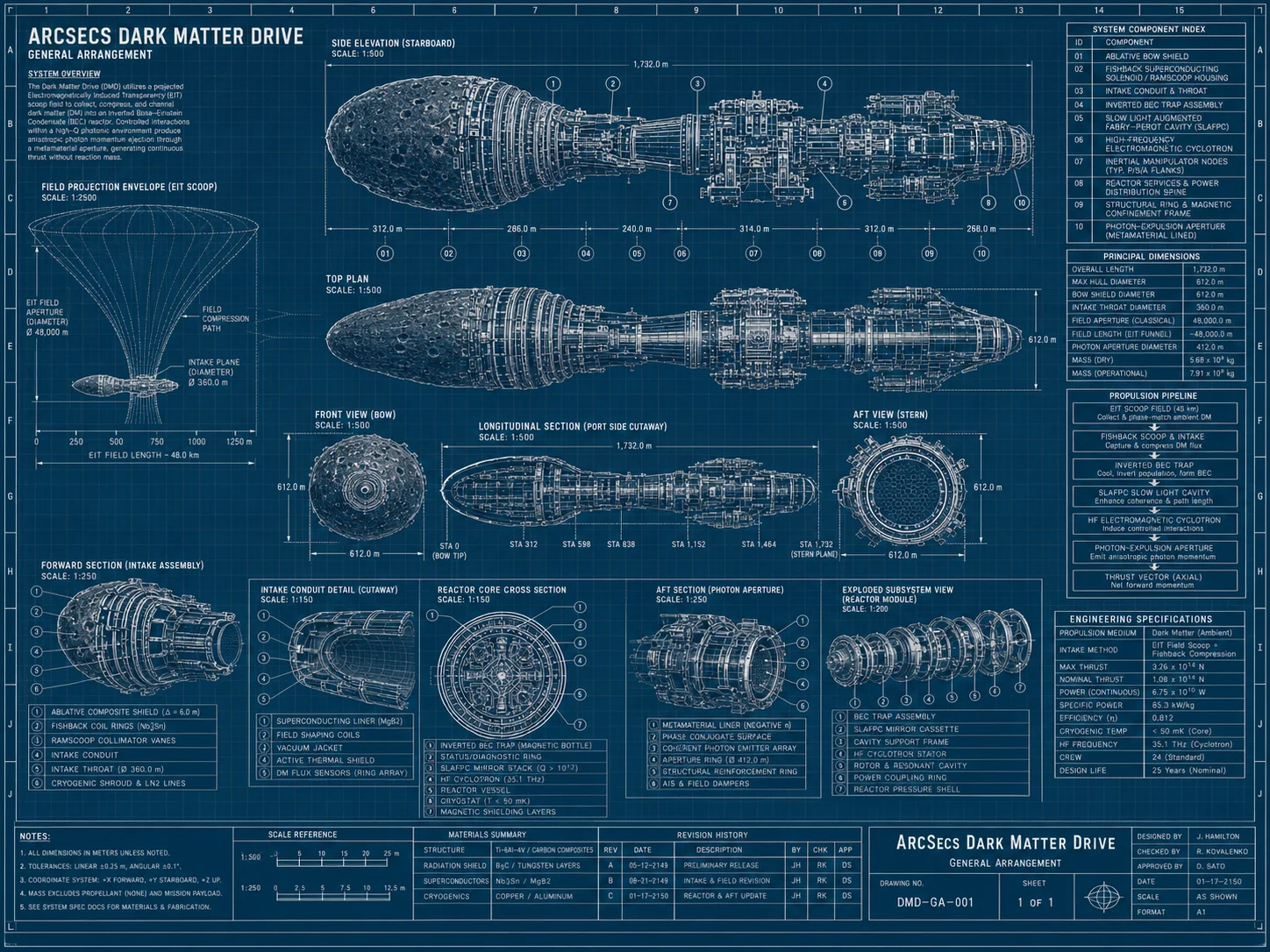
Builder schematic
The latest blueprint anchors the architecture page with scale-correct field geometry, monolithic bow shielding, sensor infrastructure, ZYRA stabilization, and exploded subsystem views.
Design rules
These are the non-negotiable constraints that keep the design aligned with the theoretical documents.
The bow is a mass shield. Use opaque cratered material, luminous impact flashes, and violent edge glow.
The aft section should read as a photon-expulsion aperture or high-Q radiation emitter, not chemical or fusion plumbing.
The framework says static Euclidean void and relational motion. Use relational inertia, distant cosmic shells, and field interference.