Diffuse ocean
Tired-light dark matter exists as a cold, weakly interacting massive-photon substrate distributed through the surrounding void.
Macroscopic field ingestion
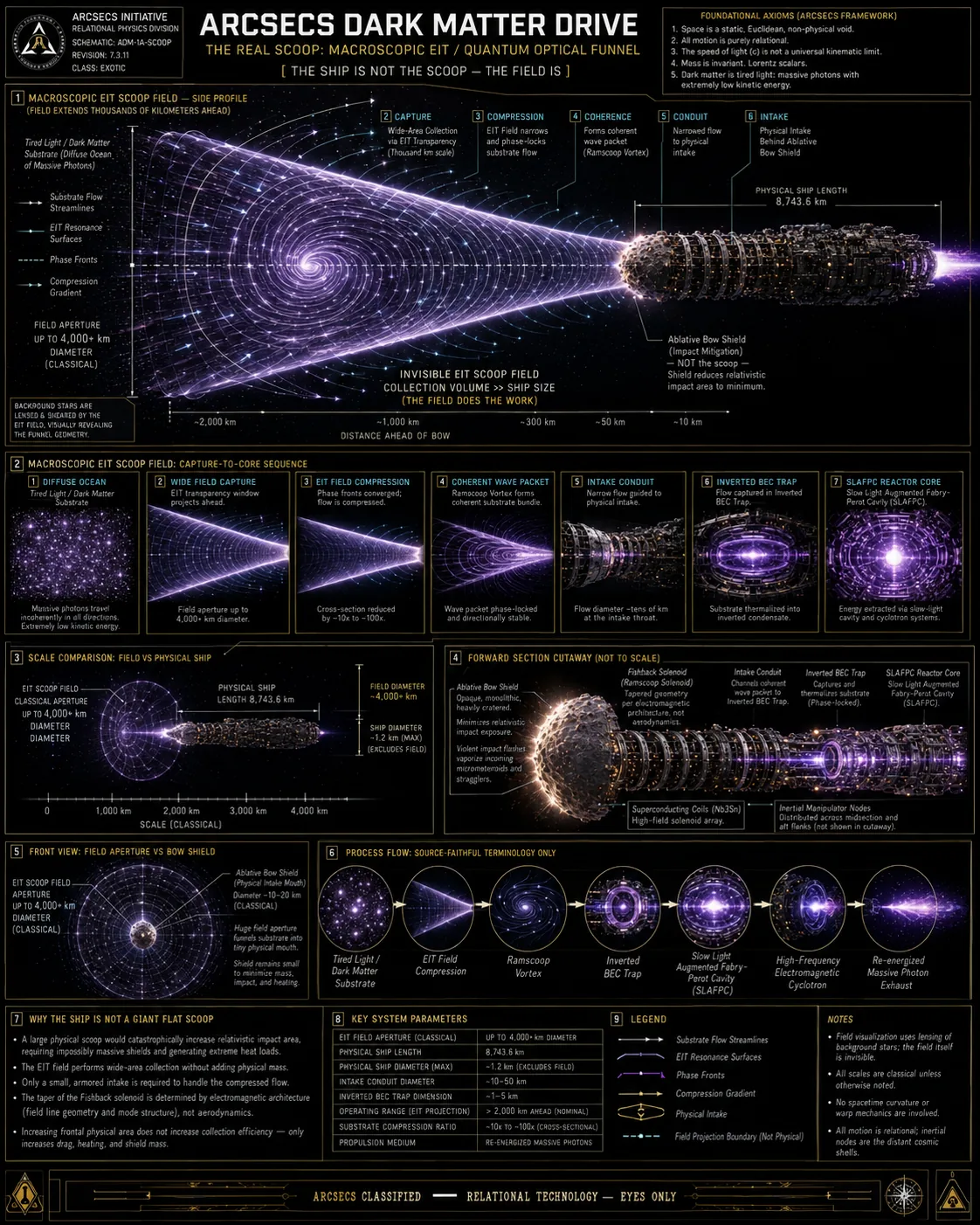
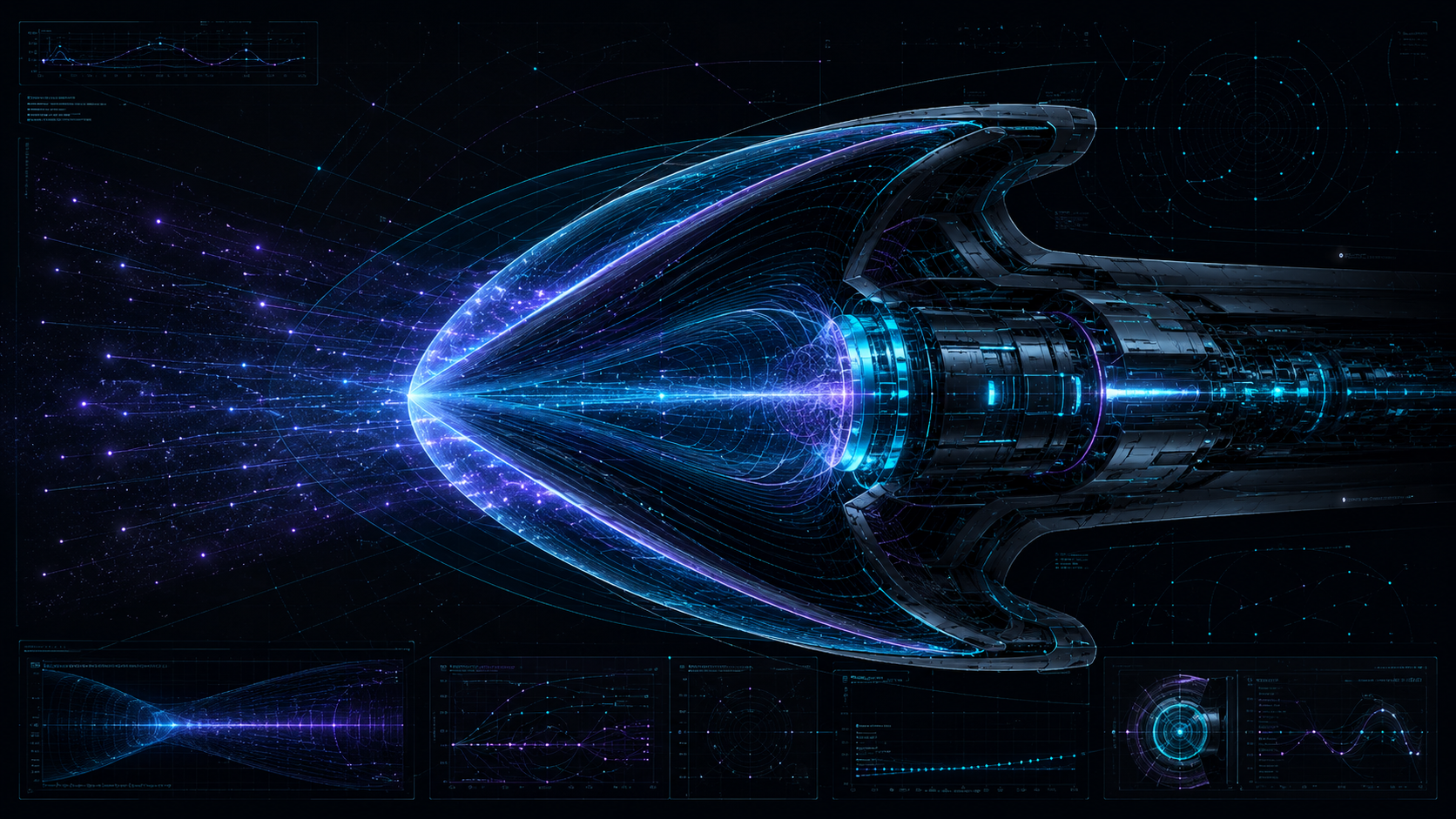
The spacecraft does not widen its physical nose to grab more material. It projects a massive EIT / quantum optical collection volume ahead of the bow, compressing tired-light dark matter into a coherent stream before it ever reaches the physical intake.
Scale breakthrough
The physical bow minimizes impact area. The projected field maximizes collection area. That is the central engineering trade.
The dark matter substrate is described as optically invisible tired light: extremely low-energy massive photons distributed through the void. The field opens a large capture window, changes the local optical dispersion condition, and organizes that diffuse substrate into a coherent inflow.
That is why the front of the ship does not need to become a massive flat wall. A wider physical scoop would multiply relativistic impact area, shielding mass, heat load, and structural penalty. A projected field can be wide without carrying a giant slab of ablative armor.
Capture-to-core sequence
The intake is best understood as a six-stage funnel, not as a mechanical mouth.
Tired-light dark matter exists as a cold, weakly interacting massive-photon substrate distributed through the surrounding void.
A macroscopic EIT field projects ahead of the ship, creating an optical condition that makes the sluggish substrate susceptible to guided compression.
Phase fronts converge. The substrate is not scooped by metal; it is organized into a narrowing volume by field geometry.
The ramscoop vortex phase-locks the inflow into a directional bundle aimed at the physical intake throat.
The compressed packet is captured and stabilized as a condensate-like feedstock before entering the reactor complex.
The Slow Light Augmented Fabry-Perot Cavity compacts the substrate through resonant reflection and extreme phase sensitivity.
Why the area is massive
The collection area becomes enormous because the field acts on the surrounding substrate before the substrate reaches the ship. The physical mouth only receives the already-compressed stream.
The tired-light medium is treated as an optically invisible ocean of low-energy massive photons. At rest it is not flowing into the ship; the drive must impose a capture geometry on it.
The projected field creates a large transparency and dispersion volume ahead of the bow. In the site model, that volume makes the slow substrate phase-responsive and steerable.
What looks like a cone is not a solid cone. It is a nested set of resonance surfaces and compression gradients that guide the substrate inward.
As the field narrows, background starlight appears to lens into a spiral because the substrate density and optical properties are changing along the intake axis.
The bow remains compact to reduce relativistic impact area. The intake only handles the compressed feed, not the full collection aperture.
By the time material reaches the ship, it has been organized into a coherent stream that can be trapped, densified, and re-energized.
Interactive explainer
Move the controls to see the difference between the invisible collection volume and the armored physical intake. The numbers are conceptual scale indicators for explaining the field geometry.
Design consequence
The field lets the drive increase collection area without increasing the destructive frontal area that must be armored against relativistic dust.
| Design choice | What gets larger | Penalty | Why the EIT field wins |
|---|---|---|---|
| Giant flat physical scoop | Armored impact face | Shield mass, heating, crater damage, structural load, and catastrophic debris exposure all scale upward. | Bad trade: collection and collision area are the same thing. |
| Compact armored bow + projected EIT field | Invisible capture volume | The physical shield stays minimized while the field performs wide-area substrate organization. | Good trade: collection aperture separates from impact area. |
| Fishback solenoid taper | Field-guiding structure | The coil geometry is complex and high-stress, but it does not require a huge flat shield. | It shapes resonance and flow rather than pushing through matter like a plow. |
Reference schematic
Open the image to inspect the side profile, front aperture view, cutaway, and process flow.