
Pre-arrival void
The vessel is inbound, but approach light cannot outrun the ship. The destination sky appears empty.
External observer paradox
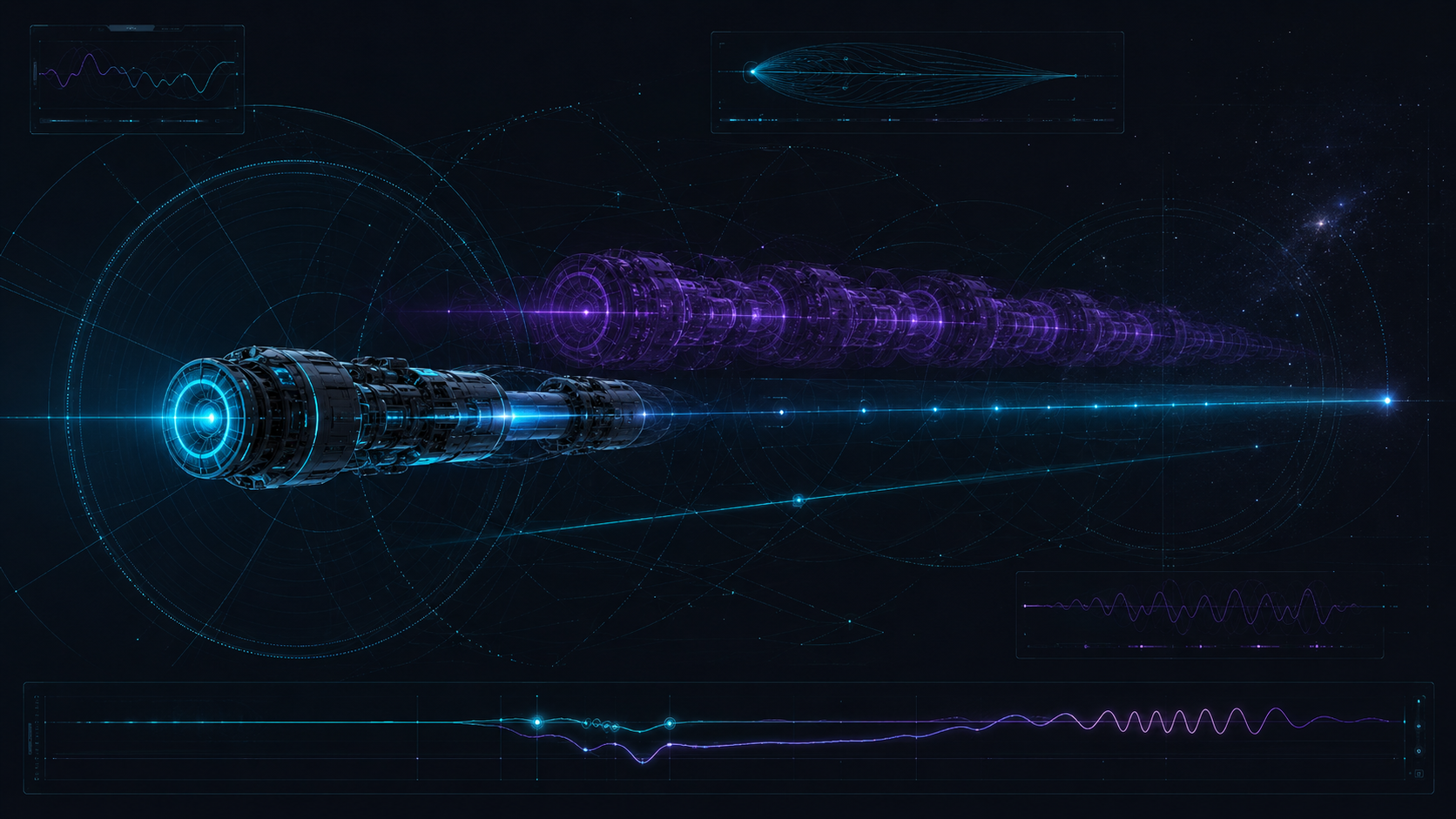
At superluminal relational velocity, the first thing an observer sees is not an approach. The physical vessel arrives first; its optical history arrives later as a backward-traveling ghost.
Event sequence
The effect is not time travel. It is an observational ordering problem: the vessel outruns the light that would normally announce its approach.
The vessel is inbound, but approach light cannot outrun the ship. The destination sky appears empty.
The physical hull crosses the observer region first. The ship seems to cut into reality with no visible warning.
The projected field and hull interaction with the tired-light substrate opens a gamma/X-ray bow shock.
Light emitted during the approach arrives late, so a phantom image appears to recede along the route.
After the physical passage, a turbulent radiative scar and lensing disturbance persists in the substrate.
Interactive timeline
Drag the scrubber to compare where the vessel really is against what a stationary observer can see.
Visual language
The best depiction is not a normal flyby. It should feel like broken observational order.
The destination observer should not see the ship getting larger in a conventional cinematic shot.
Start with an empty starfield, then place the physical ship abruptly in-frame, already present.
The route lights up after the fact through delayed optical ghosts, shock illumination, and expanding high-energy wake.
The radiation structure should dwarf the hull and smear into the surrounding substrate.
Visible light is only part of the story. False-color X-ray/gamma rendering makes the wake readable.
The ghost is delayed light, not the vessel physically flying backward.