
The ship as laboratory extrapolation
The architecture scales familiar laboratory physics into an impossible macroscopic setting: cavities, condensates, polaritons, resonators, field funnels, and cryogenic stabilization.
Engineering physics dossier
This dossier folds the newest source material into the site: photon condensation, dark-state polaritons, slow-light resonators, shielding thermodynamics, Bussard/Fishback structural limits, Machian inertia, and Proca massive photons.
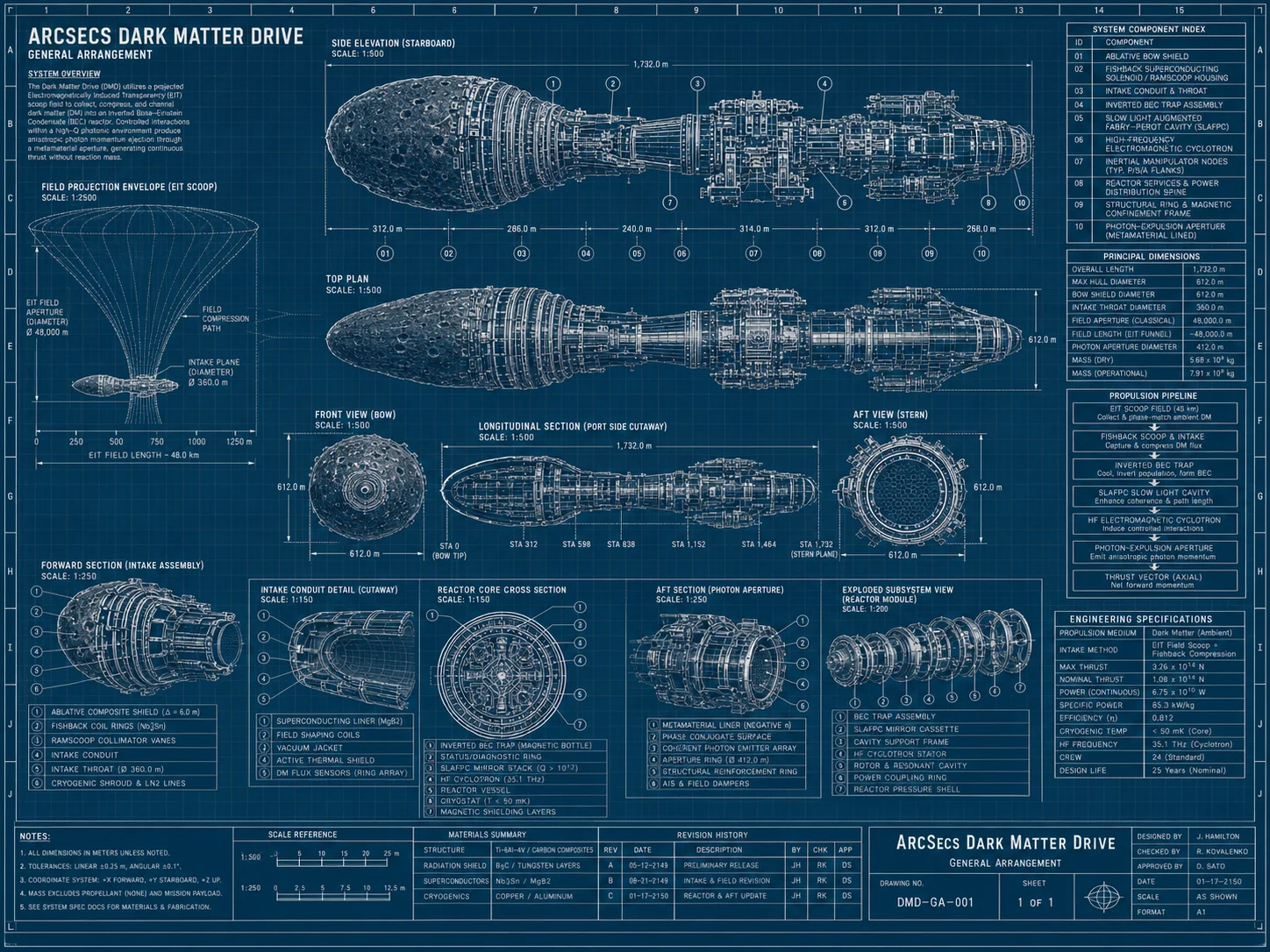
Vehicle baseline
The newest dossier treats the ArcSecs vehicle as a way to explore real quantum optics, relativistic hazards, deep-space radiation dynamics, and alternative field models at extreme engineering scale.
The architecture scales familiar laboratory physics into an impossible macroscopic setting: cavities, condensates, polaritons, resonators, field funnels, and cryogenic stabilization.
At relativistic velocity, the interstellar medium becomes a continuous impact and radiation source. The bow is therefore a thermal, radiological, and structural system first.
Machian inertia and Proca electrodynamics are used as operating assumptions inside the fictional framework, while the page keeps the public boundary clear.
Quantum optics stack
The site now separates the real ancestry from the speculative scaling. The complete machine is fictional, but many mechanisms have real laboratory analogues.
| System | Real-world physics basis | Drive-scale extrapolation |
|---|---|---|
| Photon BEC / inverted BEC trap | Photon Bose-Einstein condensates can be produced in optical microcavities by giving trapped photons an effective mass and thermalizing them through repeated absorption and emission. | The drive imagines a kilometer-class trap that stabilizes incoming tired-light substrate as a coherent reaction-mass feed. |
| EIT scoop field | Electromagnetically Induced Transparency uses control/probe fields and destructive interference to create a narrow transparency window and steep dispersion. | The site scales this into a vast projected capture condition that steers diffuse dark-state substrate into the intake without making the physical bow enormous. |
| Dark-state polaritons | Stopped-light experiments can store optical information in atomic spin coherence as a hybrid light-matter excitation. | The ramscoop explanation uses polariton-style language to show how the incoming medium becomes controllable before entering the conduit. |
| SLAFPC cavity | Fabry-Perot resonators use reflective boundaries to extend interaction path length; adding slow-light media increases delay and phase sensitivity. | The reactor cavity compacts, phase-locks, and prepares the massive-photon condensate before cyclotron re-energization. |
Relativistic shielding
The newest document adds a useful applied-physics frame for why the bow must be monolithic, layered, and violently ablative.
| Velocity | ISM heat flux | Graphite equilibrium | Steel equilibrium | Design consequence |
|---|---|---|---|---|
| 0.6c | 10,800 W/m² | 670 K | 723 K | Continuous active cooling and ablation begin to matter. |
| 0.7c | 22,700 W/m² | 805 K | 869 K | Shield material selection becomes mission-critical. |
| 0.8c | 51,400 W/m² | 988 K | 1,070 K | Thermal loading pushes ordinary structural assumptions toward failure. |
| 0.9c | 154,000 W/m² | 1,300 K | 1,400 K | The bow must behave like a sacrificial heat engine, not decorative armor. |
Ice, graphite, boron carbide, and similar low-Z materials reduce secondary bremsstrahlung generation when charged particles decelerate.
The shield works by sacrificial phase change: impact energy vaporizes expendable material and carries heat away from the hull.
Dense materials belong deeper in the stack where they absorb residual X-ray/gamma radiation rather than generating the first cascade.
Dark Matter Drive ramjet limits
The Bussard ramjet ancestry is real, but classical proton scoops run into drag, fusion-rate, and structural constraints. The Dark Matter Drive site uses those constraints to make the dark-matter field scoop feel necessary.
The basic idea of collecting ambient interstellar material instead of carrying all reaction mass comes from serious theoretical propulsion history.
Magnetic scoop fields produce enormous momentum flux and coil stress; support mass grows sharply as velocity rises.
Beamed power and catalytic fusion ideas show why hybrid support systems are plausible in the visual language of the site.
The drive avoids a normal proton-scoop penalty by treating the fuel as a massive-photon condensate handled through field optics rather than baryonic intake.
A large collection area is needed, but making that area physical would multiply impact hazards. The field separates capture from collision.
The physical conduit handles a pre-compressed coherent flow, not the full 4,000-kilometer collection aperture.
Alternative frameworks
The site should sound confident inside its own framework while still giving readers a clear public-facing boundary.
Mach's principle ties local inertial frames to the distribution of distant matter. The Dark Matter Drive turns that idea into distributed inertial coupler nodes across the midsection and aft flanks.
Proca's massive vector field equations make a non-zero photon mass mathematically expressible. The drive mythology treats tired light as a massive photon condensate that can be trapped, accelerated, and expelled.