Fastest newly emitted light
Near the source galaxy, light is treated as high-kinetic radiation moving at the local maximum phase condition of the interaction medium.
Photonic deceleration map
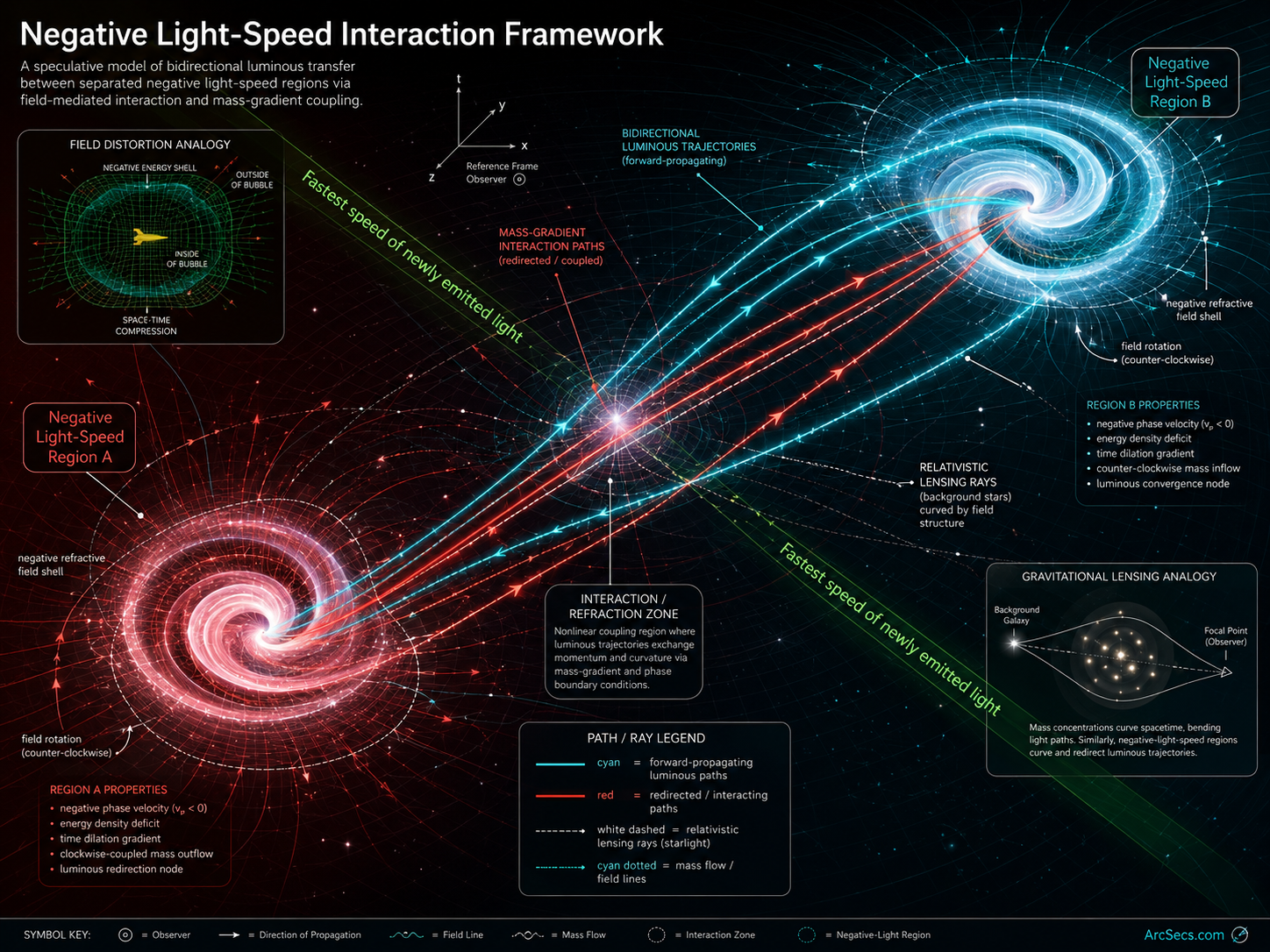
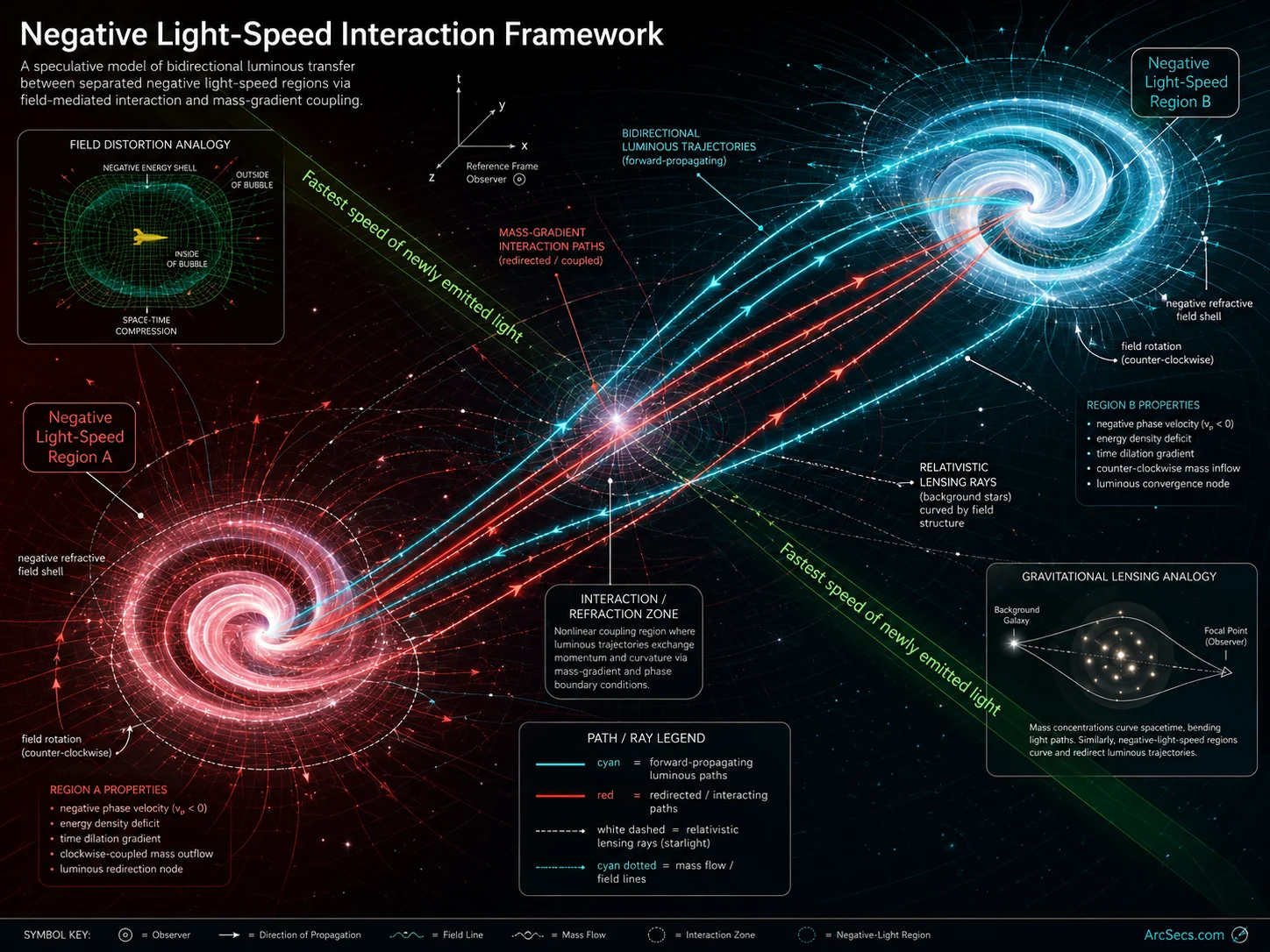
This page now explains the schematic instead of only displaying it. In the Dark Matter Drive model, negative light-speed is not time reversal. It is the mapped end-state where massive photons lose forward group behavior, become gravitationally captured, and accumulate as tired-light dark condensate.
Interpretation
The plate is a fuel-density and propagation-state map for the Dark Matter Drive. Red and cyan paths show how light leaves a high-energy emission state and approaches a captured dark-condensate state.
Near the source galaxy, light is treated as high-kinetic radiation moving at the local maximum phase condition of the interaction medium.
Across the void, the framework treats the photon as interacting with ambient fields and gradually losing useful propagation energy.
Near the receiver, the label marks extreme gravitational capture and phase binding, not backward time travel.
When forward optical behavior collapses, the old light is described as pooling into a cold, gravitationally active condensate.
Those dense captured zones become the places where the Dark Matter Drive can theoretically harvest tired-light dark matter.
The aft cyclotron does the reverse operation: it re-energizes massive photons and expels them as a hyper-luminous exhaust stream.
Clarification
The page should make this unambiguous for readers. The negative sign is an interaction label: reverse boundary condition, phase-conjugate behavior, capture dominance, or gravitational binding relative to the emission state.
| Misread | Better ArcSecs reading | Why it matters for the drive |
|---|---|---|
| Light travels backward through time. | The photon is entering a phase-captured or gravitationally bound state. | The ship is mapping usable dark substrate, not time portals. |
| The red and cyan paths are decorative beams. | They are propagation-state tracks from fresh radiation to tired-light condensate. | They define where fuel density and optical drag should be highest. |
| The vortex means spacetime is warping. | The vortex is a mass-gradient and refractive-field structure around captured light. | The same logic supports the ramjet interpretation of warp-bubble visuals. |
| The receiver galaxy is passive. | The receiver is a gravitational and electromagnetic capture topology. | Navigation must account for active capture fields near dense galactic cores. |
Full schematic
Click the image to open the full-resolution version. It should now read as a propagation-state map, a lensing map, and a Dark Matter Drive fuel map at the same time.
Drive connection
The negative-light-speed framework connects the cosmology pages to the ship pages: it explains what the drive harvests, why the scoop exists, and why massive photon exhaust is the reverse of tired-light aging.
Fresh stellar radiation begins in a high-energy, high-frequency state near the source galaxy.
Across long distances, the model treats light as losing kinetic propagation energy through field interaction.
At dense galactic wells, old light is modeled as entering a gravitationally bound negative-light-speed region.
The captured field becomes a cold, optically dark, massive-photon reservoir: the drive fuel substrate.
The Dark Matter Drive gathers the condensate, compresses it, restores kinetic energy, and expels it as thrust.