
The observation
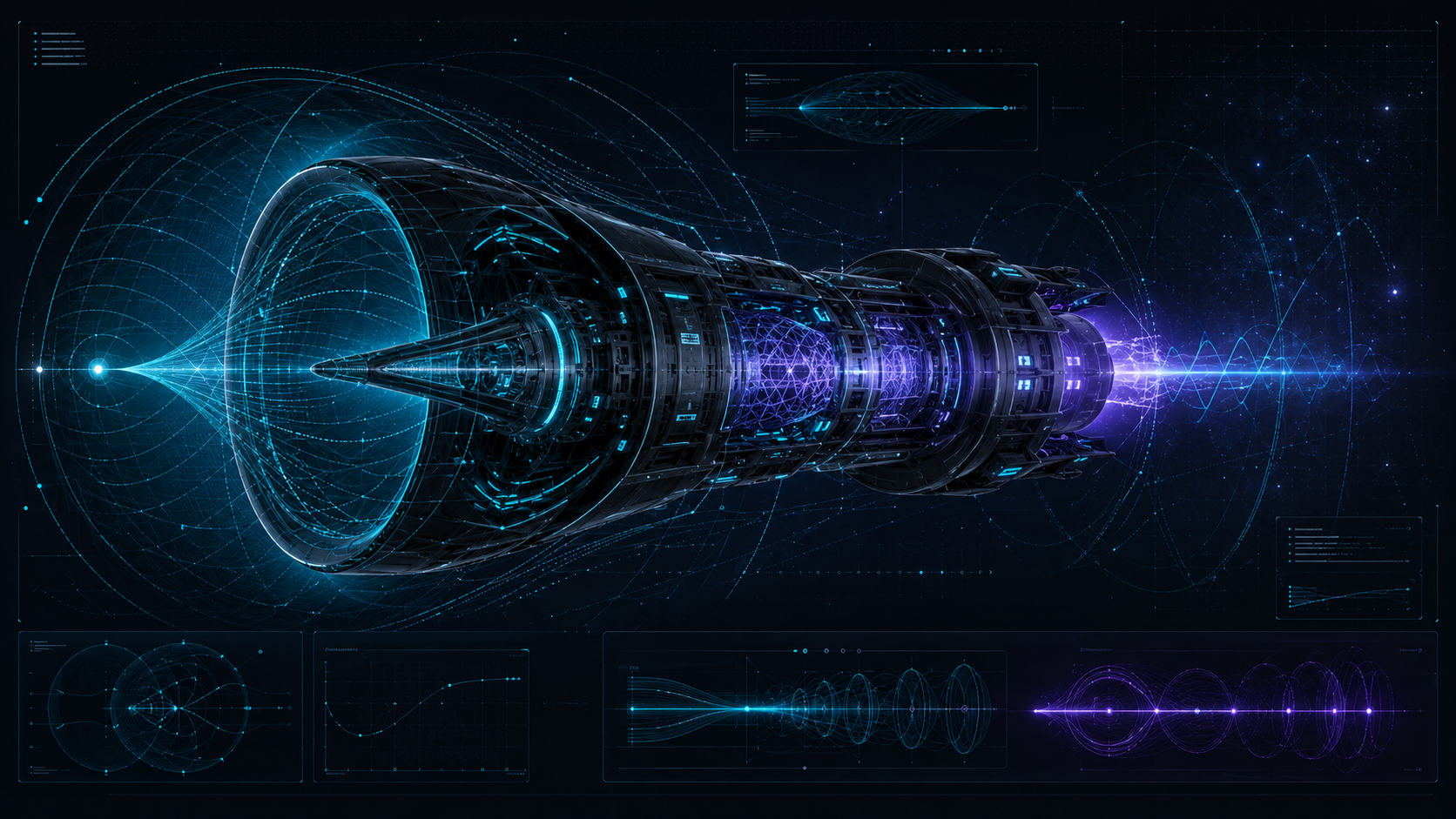
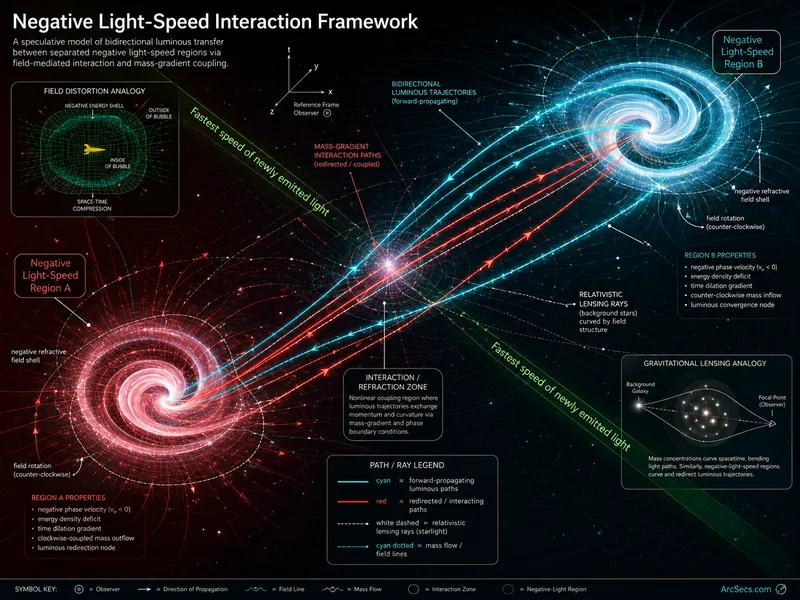
A distant observer sees light bending, field distortion, forward compression, aft wake, and abnormal kinematics around the craft.
Propulsion interpretation
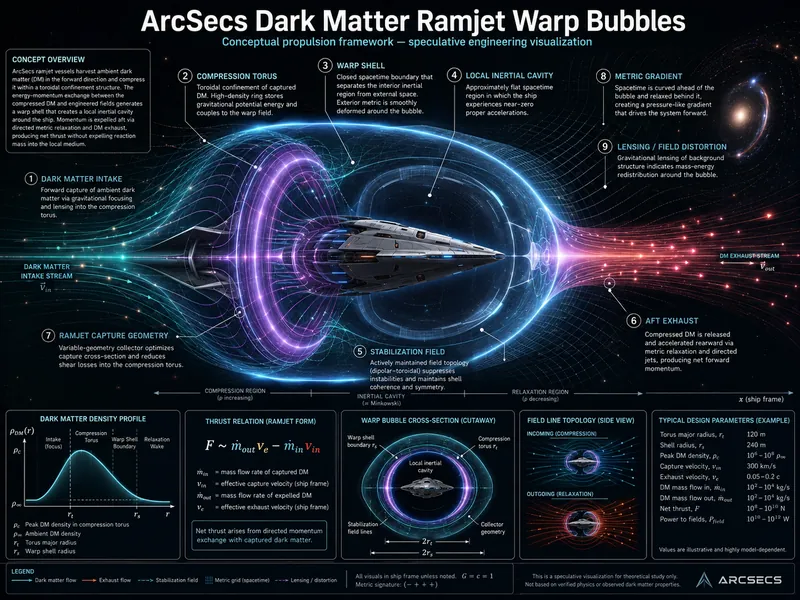
The Dark Matter Ramjet is the propulsion-specific interpretation inside the broader Dark Matter Drive concept: a no-spacetime, mass-flow reinterpretation of the warp bubble built from dark matter intake, EIT compression, SLAFPC/BEC trapping, relational inertia control, cyclotron re-energization, and massive photon exhaust.
System thesis
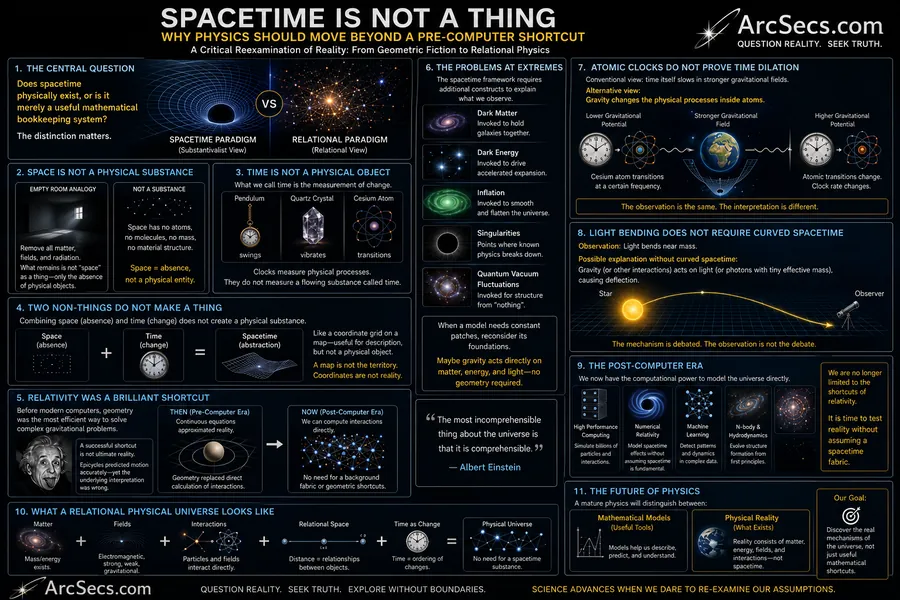
On DarkMatterDrive.com, Dark Matter Drive is the broad site term and Dark Matter Ramjet is the engine-specific label. This page focuses on the ramjet side of the story: not a ship inside bent spacetime, but a physical engine moving an invisible substrate.
A distant observer sees light bending, field distortion, forward compression, aft wake, and abnormal kinematics around the craft.
The conventional interpretation calls that visual pattern a spacetime warp bubble: contraction ahead, expansion behind, and a locally flat cavity inside.
The same signature can be read as dark matter intake, compression, re-energization, and massive photon exhaust - a physical mass-flow envelope.
Primary schematic
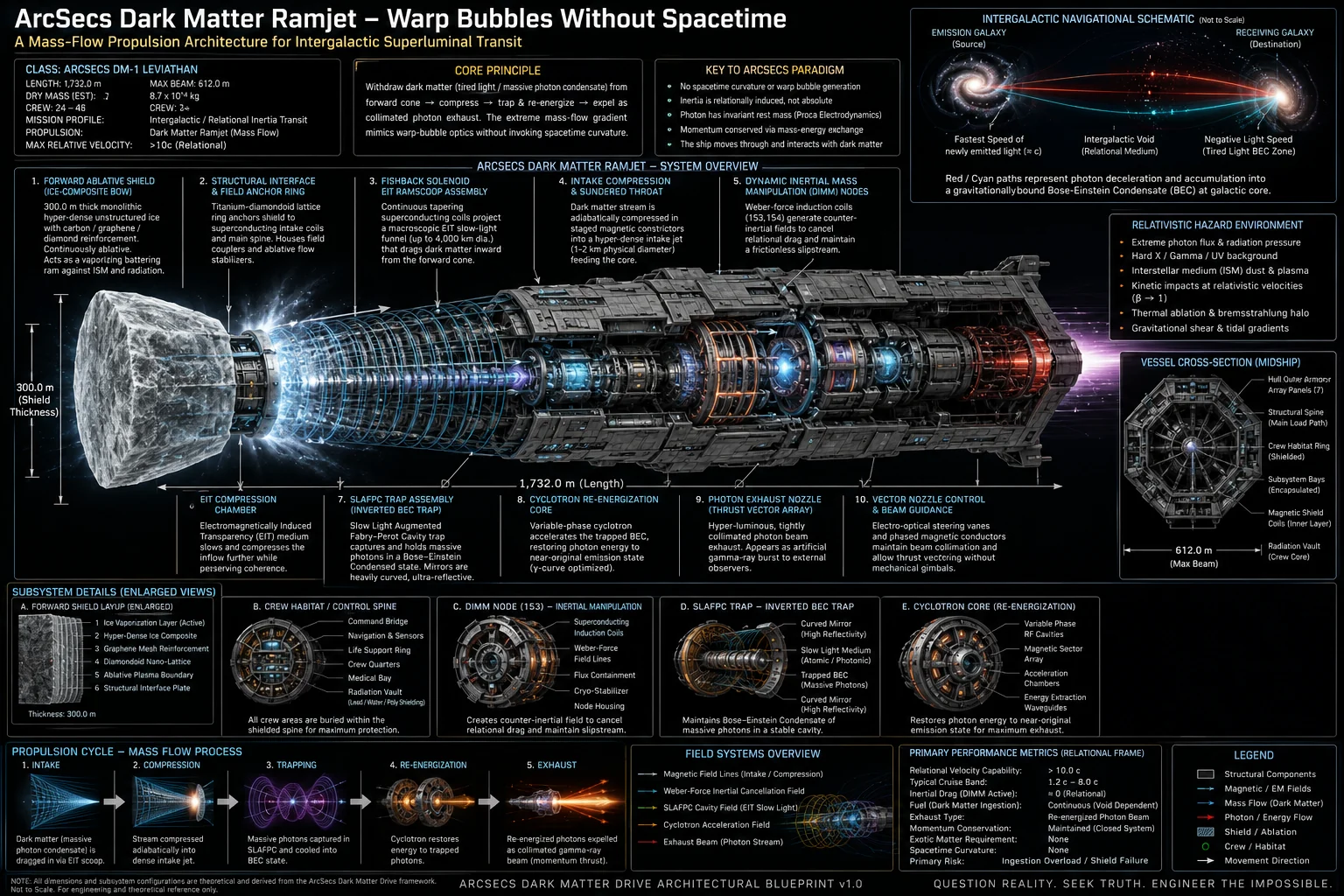
This is the image to use for the main page, social previews, and high-resolution inspection. It includes the subsystem list, cross-section, propulsion cycle, field legend, and performance metrics.
Vehicle systems
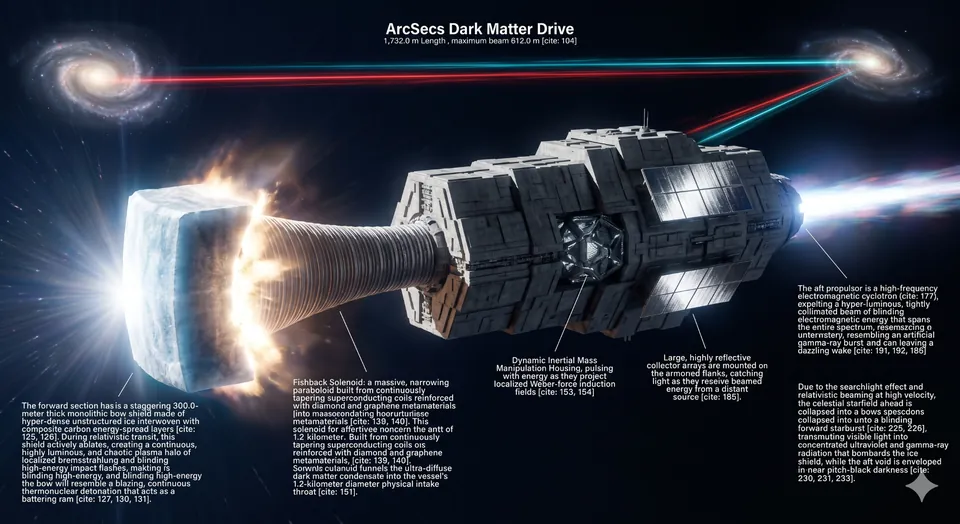
The new schematic is stronger because it separates impact survival, collection, compression, storage, re-energization, and exhaust instead of treating the ship as a vague glowing bubble.
A hyper-dense ice-composite bow shield vaporizes incoming dust and hydrogen, creating the luminous plasma and bremsstrahlung halo expected at relativistic speeds.
A titanium-diamondoid lattice couples the shield to the superconducting intake coils and prevents impact shock from propagating through the hull.
Continuously tapering coils project the macroscopic EIT slow-light funnel that captures and phase-organizes ambient dark condensate.
The dark matter stream is adiabatically compressed through staged magnetic constrictors into a hyper-dense physical intake feed.
Weber-force induction coils modulate counter-inertial fields so the incoming substrate can enter a frictionless slipstream instead of creating Bussard-style drag.
A Slow Light Augmented Fabry-Perot Cavity captures massive photons into a coherent, cooled, high-density reaction-mass state.
Variable-phase electromagnetic cavities accelerate trapped massive photons back toward a high-energy emission state.
Large flank collectors receive beamed energy from distant infrastructure to power the cyclotron and field systems.
The aft aperture emits a hyper-luminous, tightly collimated massive-photon beam that functions as physical exhaust.
Electro-optical steering vanes and phased magnetic conductors maintain exhaust collimation and steering without mechanical gimbals.
Mass-flow cycle
The core engine sequence is physical rather than geometric: intake, compression, trapping, re-energization, and exhaust.
Ambient tired-light condensate is gathered through the EIT field.
The stream is slowed, phase-organized, and concentrated into the throat.
Massive photons are captured in the SLAFPC and cooled into a coherent fuel state.
The cyclotron restores kinetic energy to the trapped substrate.
Re-energized massive photons exit as a collimated gamma-ray-like thrust beam.
DIMM nodes reduce relational drag while the ship accelerates through the void.
Updated schematic set
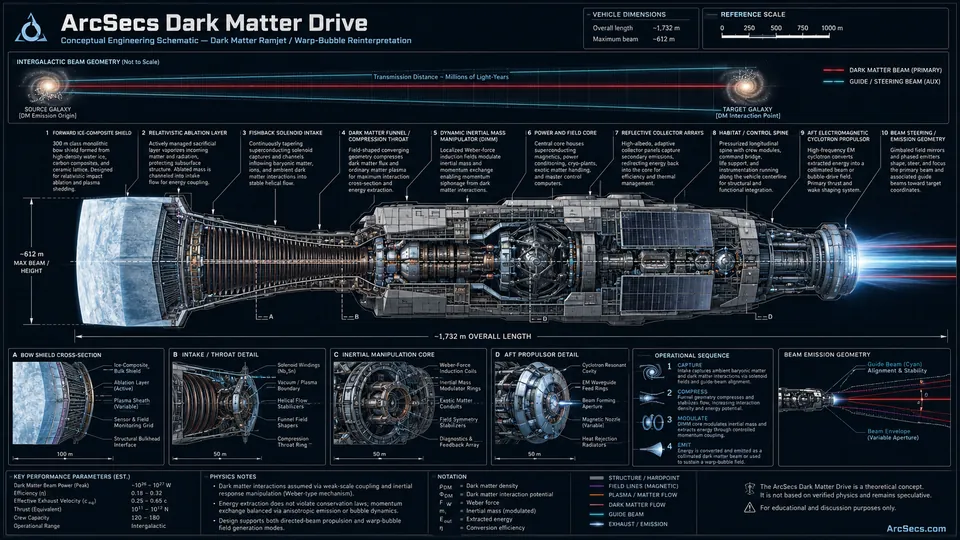
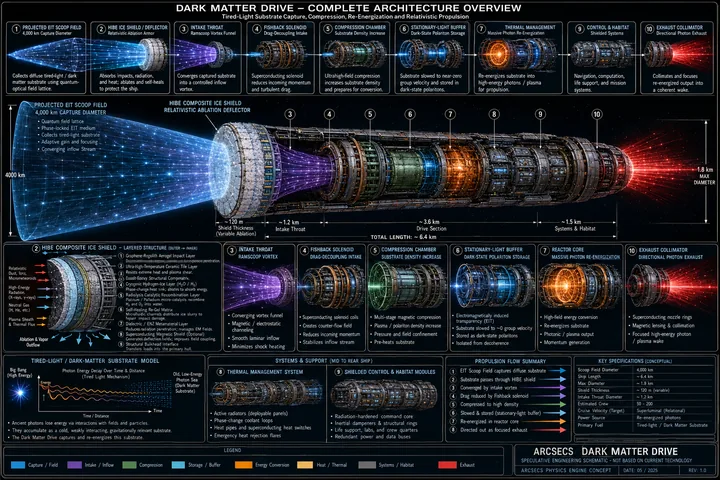
The theme now includes every major schematic uploaded for the revised architecture. Open each plate full-screen from this page or the gallery.
Publication notes
The theme is intentionally clear that this is a speculative ArcSecs framework. The pages separate verified physics ancestry from the speculative engineering synthesis.
The site references real concepts such as gravitational lensing, Bussard ramjets, EIT slow light, Fabry-Perot cavities, photon-BEC experiments, Proca-style photon mass limits, and relativistic optical effects.
The ArcSecs leap is combining those ideas into tired-light dark matter, relational inertia, dark-matter intake, massive photon exhaust, and superluminal ramjet architecture.
Every schematic is framed as conceptual engineering visualization, not verified spacecraft technology. The goal is to make the argument inspectable and testable.