
Truth primitive
Use parsecs, megaparsecs, gigaparsecs, parallax arcseconds, and gravitational-wave standard-siren distance as the primary measurement lane.
Integration contract
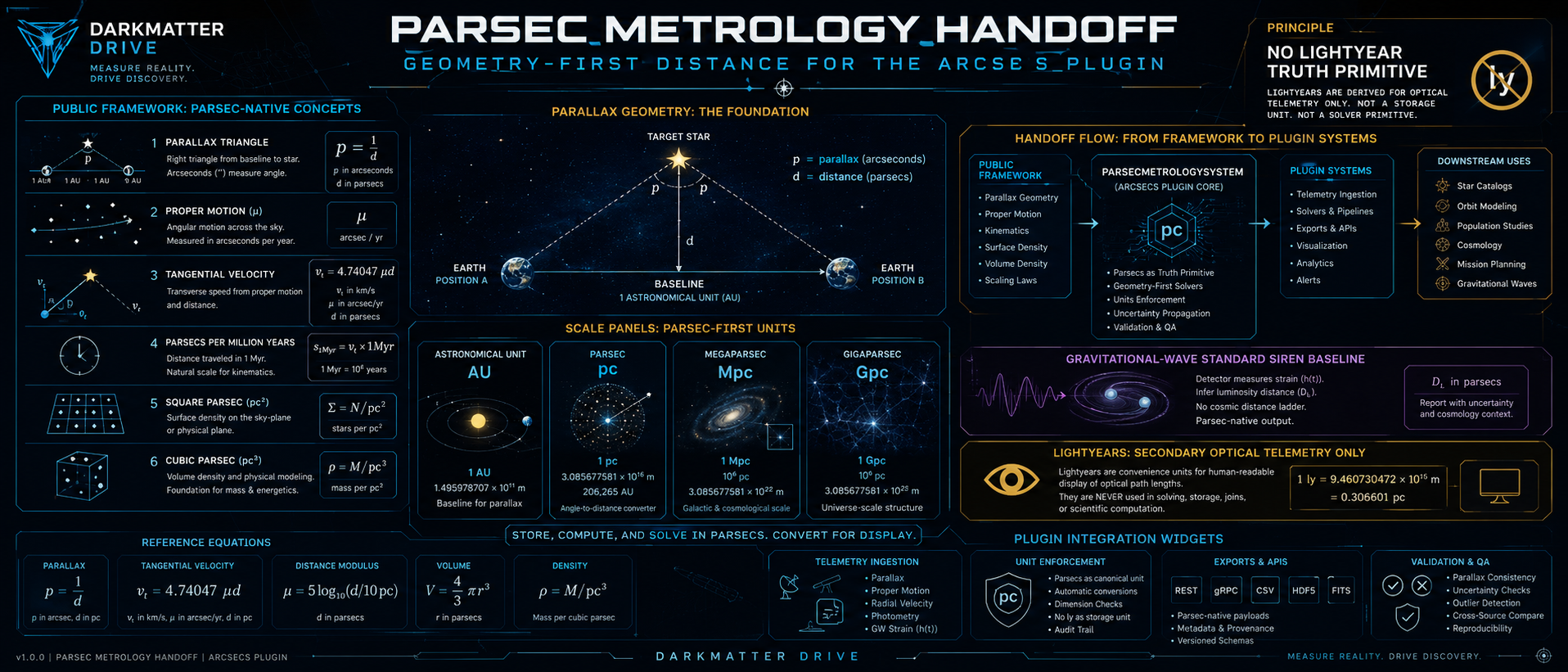
A focused contract for the ArcSecs integration reviewer: wire distance without lightyears into the Physics Engine Demo and Dark Matter Drive Simulator using parsecs, parallax, proper motion, square/cubic parsecs, and gravitational-wave baselines.
Implementation goal
This contract converts the Parsecs for Speed and Area report into concrete simulator requirements. The runtime integration may display lightyear comparisons for readers, but the baseline telemetry should be parsec-native.
Use parsecs, megaparsecs, gigaparsecs, parallax arcseconds, and gravitational-wave standard-siren distance as the primary measurement lane.
Lightyear and photon time-of-flight values may appear only as degraded, delayed, path-dependent optical telemetry.
All seven export targets must preserve parsec-native fields, UTC timestamps, caveats, falsification notes, and finite telemetry guards.
Required systems
These systems stay inside the ArcSecs plugin. The WordPress theme only publishes the contract and documentation.
Use parsec, megaparsec, gigaparsec, arcsecond, proper-motion, and gravitational-wave-standard-siren values as baseline distance telemetry.
Convert parallax arcseconds to parsecs, proper motion to tangential velocity, and square/cubic parsec density values without using lightyear as a truth primitive.
Use global/relational chronology telemetry for velocity denominators and keep local atomic clocks as affected instruments, not universal time sources.
Keep gravitational-wave or geometry-derived distance as the baseline lane for multi-messenger distance checks.
Treat electromagnetic/lightyear-derived values as delayed, degraded, density-sensitive optical telemetry.
Record the claim boundary that lightyears are optical telemetry and parsecs/gravity baselines are the active simulator measurement lane.
Measurement primitives
Each primitive should have finite numeric guards before it reaches UI telemetry or export payloads.
| Primitive | Derived unit | Formula / rule | Guard |
|---|---|---|---|
| Parallax arcseconds | parsecs | distanceParsecs = 1 / parallaxArcseconds |
parallaxArcseconds must be finite and greater than zero. |
| Proper motion tangential velocity | kilometers per second or parsecs per million years | tangentialVelocityKmPerSecond = 4.74047 * properMotionArcsecondsPerYear * distanceParsecs |
proper motion and distance must be finite. |
| Parsecs per million years | native simulator velocity | approximately 1 km/s equals approximately 1.0227 pc/Myr |
Use as kinematic display scale, not a light-travel distance. |
| Square parsec surface density | surface density and intensity maps | surfaceDensity = measuredQuantity / areaSquareParsecs |
Area must be finite and greater than zero. |
| Cubic parsec / megaparsec volume | large-scale volume maps | volume density = measuredQuantity / volume |
Volume must be finite and greater than zero. |
| Gravitational-wave standard-siren distance | multi-messenger distance baseline | distance from wave strain/chirp model, not photon time of flight |
Flag counterpart-derived optical values as secondary telemetry. |
Acceptance criteria
The pass is complete only when the live ArcSecs pages visibly use parsec-native metrology and export the same facts.
Distance-Time Kernel mode can display parsec, megaparsec, and gigaparsec values without lightyears as the baseline.
Multi-Messenger Event Theater scenes preserve gravity-wave baseline distance and label photon/light values as optical telemetry.
Simulator UI shows parsec-native speed and area readouts: pc/Myr, pc^2, pc^3, Mpc, and Gpc where appropriate.
Exports include UTC generated timestamps, caveats, falsification paths, speculative-boundary text, and finite telemetry guards.
Validation tests confirm no export target lost Operator Runbook and no prior ArcSecs event anchor was dropped.
Open arcsecs-parsec-metrology-handoff.json for the machine-readable integration contract.