
Distance-Time Kernel
The build contract for distance without lightyears and time without clocks
A simulator-facing page that converts the New Universe Framework report into concrete kernel layers for ArcSecs: geometry-first distance, gravitational-wave standard sirens, relational chronology, decoupled wavefront telemetry, supernova messenger stretch, and Hubble residual testing.
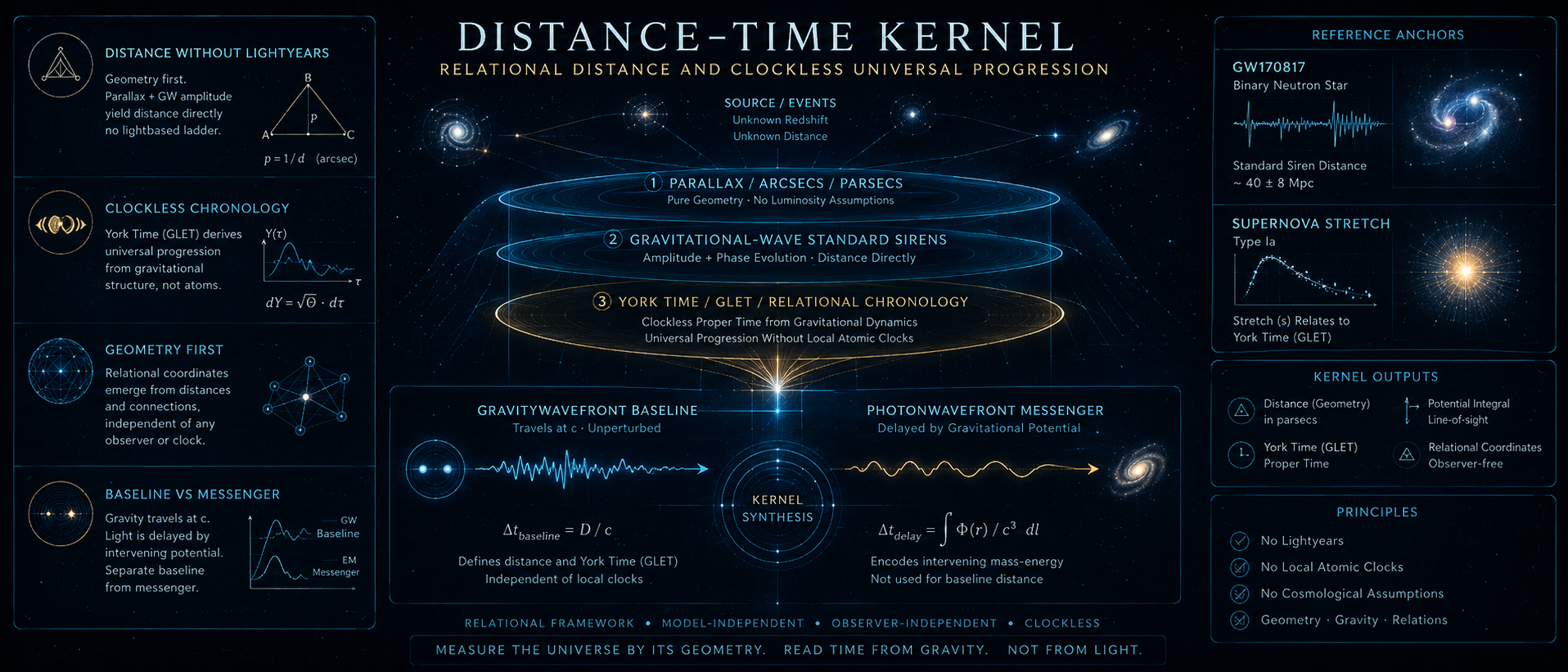
Direct answer
What the kernel does
The goal is not to argue old premises. The goal is to build an engine that can calculate from the assumptions the framework actually uses.
The Distance-Time Kernel separates truth sources from messenger readings. Distance truth comes from parsec/parallax geometry, angular relations, proper motion, and gravitational-wave standard sirens. Chronology truth comes from global relational state progression and universal synchronizers. Light and local clocks become telemetry channels that can drift, lag, stretch, or lose energy.
This lets the ArcSecs demo and Dark Matter Drive simulator show the framework honestly: gravity and geometry establish the baseline, while photons and local atomic cycles are measured as affected physical systems rather than treated as the rulers of the universe.
Simulator contract
Distance-Time Kernel
This is the simulator contract: which values count as distance truth, which values count as chronology truth, and which values are only messenger telemetry.
geometry / gravity / relational truth lane
optical / local-clock telemetry lane
distance primitive
Parallax / parsec distance kernel
Near and middle-distance geometry should be calculated from angular parallax and parsecs instead of light travel time.
System: RelationalDistanceSystem
Source section: Trigonometric Parallax and Gridless Angular Coordinates
deep-distance primitive
Gravitational-wave standard-siren kernel
For cosmological distance, use gravitational-wave strain and chirp behavior as the clean baseline before treating electromagnetic redshift as distance truth.
System: StandardSirenDistanceSystem
Source section: Gravitational Waves as Standard Sirens
universal progression primitive
Clockless relational chronology kernel
Global simulation order should be calculated from relational state change and universal synchronizers rather than from local atomic oscillators.
System: UniversalChronologySystem
Source section: Universal Clockless Time: Establishing Chronology Without Paradoxes
messenger propagation primitive
Decoupled GravityWavefront / PhotonWavefront kernel
Gravity waves and electromagnetic light should be modeled as separate messengers, with light carrying source delay, environmental diffusion, velocity attenuation, and energy degeneration.
System: MultiMessengerEventSystem
Source section: Decoupled Propagation: Modeling Light Slowing and the Covarying Cosmos
falsification pressure-test primitive
Supernova messenger-stretch kernel
Supernova light-curve stretching is the hard tired-light pressure test and must be reproduced as photon-arrival distortion without claiming literal time dilation.
System: SupernovaMessengerStretchSystem
Source section: Simulating Time Dilation as an Optical Illusion
population comparison primitive
Hubble tension residual kernel
Hubble tension should be exposed as a comparison between optical propagation history and geometry/gravitational baselines.
System: HubbleResidualSystem
Source section: Decoupled Propagation; CCC+TL Mathematical Architecture
Open distance-time-kernel.json for the machine-readable engine contract.
Event theater
Reusable Multi-Messenger Event Theater
This reusable theater keeps the framework page, kernel page, and multi-messenger page aligned with the same simulator cases and fail conditions.
GravityWavefront baseline
PhotonWavefront / optical lane
Relational chronology lane
source
environment
visibility
residual
Validation checks:
Open multi-messenger-event-theater.json for the scene contract.
Plugin source bridge
ArcSecs TypeScript source bridge
A integration contract for the public TypeScript contracts referenced by the ArcSecs comparison page. These files connect the static framework pages to the ArcSecs physics engine demo and Dark Matter Drive simulator.
Strict TypeScript / no jQuery / simulator contracts
Use these files to wire the kernel into the runtime integration
The integration reader should consume the JSON contracts, then bind them to these source contracts for deterministic steps, visible ledgers, and fail-condition telemetry.
Source-folder overview and plugin-agent handoff. Supports the public TypeScript source browser on the ArcSecs comparison page.
assets/ts/arcsecs-physics-engine/README.md
Shared strict-mode TypeScript contracts for scenario modes, entities, constants, simulation input, and telemetry frames.
assets/ts/arcsecs-physics-engine/PhysicsTypes.ts
Coordinates invariant constants, tired-light branch constants, Proca photon branch constants, and visible scenario choices.
assets/ts/arcsecs-physics-engine/ConstantsManager.ts
Runs deterministic simulation steps and conservation ledgers so speculative branches cannot hide failures.
assets/ts/arcsecs-physics-engine/CorePhysicsEngine.ts
Models a massive-photon / Proca group-velocity branch as an explicit assumption.
assets/ts/arcsecs-physics-engine/ProcaPhotonModel.ts
Keeps photon-energy attenuation and redshift-style energy loss visible.
assets/ts/arcsecs-physics-engine/TiredLightModel.ts
Calculates a simple relational influence score between massive graph nodes.
assets/ts/arcsecs-physics-engine/RelationalInertiaModel.ts
Estimates slow-light condensate density from captured/degraded photon energy.
assets/ts/arcsecs-physics-engine/DarkMatterCondensateModel.ts
Converts engine telemetry into display lines without jQuery.
assets/ts/arcsecs-physics-engine/TelemetryRenderer.ts
Maps /distance-time-kernel.json into plugin-ready modes for the ArcSecs demo and Dark Matter Drive simulator.
assets/ts/arcsecs-physics-engine/DistanceTimeKernelBridge.ts
Maps /arcsecs-parsec-metrology-handoff.json into parsec-native simulator modes, telemetry guards, export fields, and regression checks.
assets/ts/arcsecs-physics-engine/ParsecMetrologyHandoff.ts
Maps /arcsecs-plugin-agent-handoff.json into ordered plugin implementation steps and source-contract URLs.
assets/ts/arcsecs-physics-engine/PluginAgentHandoffBridge.ts
Maps /arcsecs-plugin-readiness-dashboard.json into contract readiness, validation gates, and ordered agent work queue summaries.
assets/ts/arcsecs-physics-engine/PluginReadinessDashboardBridge.ts
Defines typed export-schema stubs for Benchmark JSON, Calibration Certificate, Quality Gate, Evidence Packet, Research Bundle, and Scene JSON.
assets/ts/arcsecs-physics-engine/ExportSchemaContracts.ts
Maps live Distance-Time Kernel, Event Theater, Framework Claim Map, validation, and quality-gate telemetry into export-builder targets.
assets/ts/arcsecs-physics-engine/ExportBuilderHandoff.ts
Engine bridge
How this should land in the demos
The kernel is meant to be consumed by the ArcSecs physics engine demo and the Dark Matter Drive simulator as shared data and shared telemetry language.
ArcSecs physics engine demo
Consume /distance-time-kernel.json beside /framework-event-lab.json. Bind the kernel layers to engine systems so every event can report its distance truth source, chronology truth source, and messenger residuals.
Dark Matter Drive simulator
Add a Time & Distance Kernel panel to the simulator UI. It should show which parts of the demo are geometry/gravity baselines and which parts are optical/local-clock readings affected by path, density, or substrate interaction.
Open Dark Matter Drive simulatorFalsification behavior
Every layer includes a fail condition. The demo should display when a model branch fails instead of silently forcing every observation into light-slowing, tired-light, or no-spacetime language.
Open kernel JSONImplementation order
Next engine systems to build
This turns the report into a sequence a plugin developer or simulator agent can implement.
1. RelationalDistanceSystem
Start with parallax/parsec, angular node distance, proper motion, and standard-siren distance objects. No lightyear primitive.
2. UniversalChronologySystem
Add York-style global state, GLET-style relational change, Janus complexity, CMB proxy, and GWB synchronizer lanes.
3. Wavefront split
Keep GravityWavefront and PhotonWavefront separate so light can lag or degrade without changing the global tick.
4. Event pressure tests
Use GW170817, GW150914, GW190521, supernova stretch, and Hubble residuals as structured test cases.
5. Claim telemetry
Log claim status, source terms, environment terms, residuals, and fail conditions in every demo run.
6. Public JSON contract
Keep the simulator contract readable to users, crawlers, and future integration reviewers through /distance-time-kernel.json.