
Relational distance layer
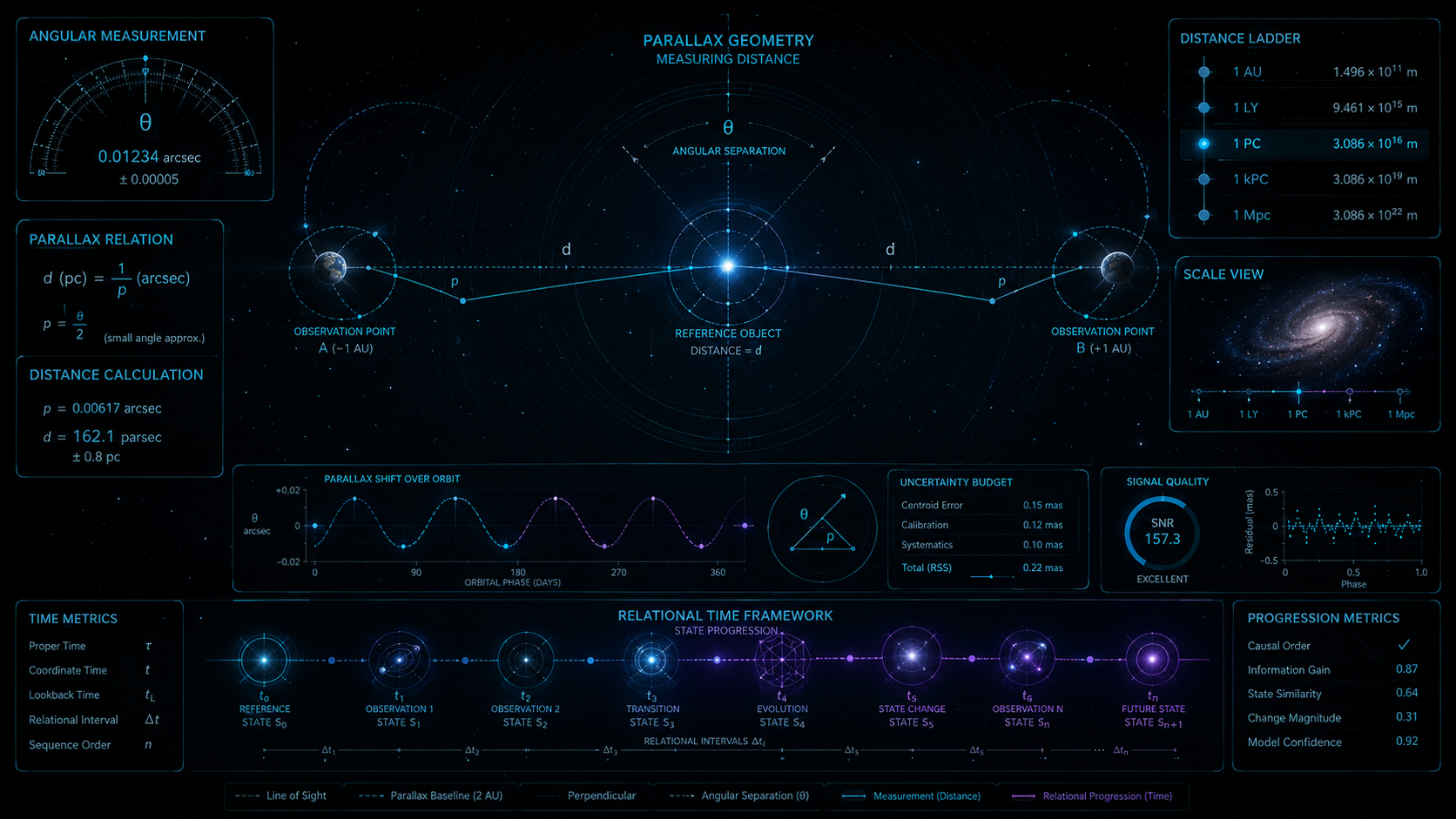
Use parsecs, parallax angles, angular separation, proper motion, and node-to-node geometry as the first-class distance system. Light travel time becomes observational metadata, not the ruler.
New universe framework
A public framework page built from the long-term New Universe Framework: Time and Distance report. It turns the no-spacetime, no-lightyear, no-local-clock position into a practical simulator roadmap for ArcSecs and Dark Matter Drive.
Direct answer
This page is intentionally written as project architecture and pressure-test framing, not as a claim that mainstream cosmology has already accepted the model.
The ArcSecs framework should calculate distance from geometry and gravity-wave baselines, not from lightyears, and should calculate chronology from global relational state progression, not from local atomic clocks.
The working model treats electromagnetic light as a secondary messenger whose speed, energy, and arrival interval may be path-dependent. The physics engine should therefore keep light measurements separate from distance truth and keep local clock behavior separate from universal state order.
For implementation, this means the engine needs separate distance, chronology, and messenger systems: parsec/parallax geometry, gravitational-wave standard-siren distance, relational clockless time, and a PhotonWavefront layer that can slow, tire, stretch, or arrive late without forcing the whole universe into spacetime language.
Calculation stack
The framework becomes useful when every idea maps to a simulator data structure.
Use parsecs, parallax angles, angular separation, proper motion, and node-to-node geometry as the first-class distance system. Light travel time becomes observational metadata, not the ruler.
Use standard sirens and dark standard sirens as the long-baseline distance and arrival-order reference, especially where parallax is too small.
Use York-time-style global state, GLET/Jacobi-Barbour-Bertotti relational change, Janus Point complexity, CMB cooling, and gravitational-wave-background synchronizers as candidate global chronology signals.
Model photons separately from gravity waves. Track velocity attenuation, energy degeneration, arrival interval stretching, local source delay, and environmental diffusion before interpreting redshift or optical delay.
Simulator contract
The same kernel is embedded here so the public framework page maps directly into engine systems instead of remaining article copy.
distance primitive
Near and middle-distance geometry should be calculated from angular parallax and parsecs instead of light travel time.
deep-distance primitive
For cosmological distance, use gravitational-wave strain and chirp behavior as the clean baseline before treating electromagnetic redshift as distance truth.
universal progression primitive
Global simulation order should be calculated from relational state change and universal synchronizers rather than from local atomic oscillators.
messenger propagation primitive
Gravity waves and electromagnetic light should be modeled as separate messengers, with light carrying source delay, environmental diffusion, velocity attenuation, and energy degeneration.
falsification pressure-test primitive
Supernova light-curve stretching is the hard tired-light pressure test and must be reproduced as photon-arrival distortion without claiming literal time dilation.
population comparison primitive
Hubble tension should be exposed as a comparison between optical propagation history and geometry/gravitational baselines.
Open distance-time-kernel.json for the machine-readable engine contract.
Reference events
These are not treated as proof by themselves. They are structured test cases that force the model to separate source physics, environment, and propagation history.
GW170817
Use as the clean tutorial case for gravitational-wave baseline plus electromagnetic counterpart, while separating source delay from propagation residual.
GW150914
Use as the caution case for disputed counterpart quality and false-positive handling.
GW190521
Use as the dense-environment case where optical flare delay should be modeled separately from universal propagation delay.
Supernova time dilation
Use as the required optical-light-curve challenge: the framework must reproduce stretching without literal time dilation.
Hubble tension
Use as a question of optical propagation history versus gravitational/geometry baselines.
Interactive lab
A reusable simulator-facing panel that turns the long-term framework report into event controls for distance without lightyears and chronology without local clocks.
Open framework-event-lab.json for the machine-readable version.
Event theater
This reusable theater keeps the framework page, kernel page, and multi-messenger page aligned with the same simulator cases and fail conditions.
Open multi-messenger-event-theater.json for the scene contract.
Plugin source bridge
A integration contract for the public TypeScript contracts referenced by the ArcSecs comparison page. These files connect the static framework pages to the ArcSecs physics engine demo and Dark Matter Drive simulator.
Strict TypeScript / no jQuery / simulator contracts
The integration reader should consume the JSON contracts, then bind them to these source contracts for deterministic steps, visible ledgers, and fail-condition telemetry.
Source-folder overview and plugin-agent handoff. Supports the public TypeScript source browser on the ArcSecs comparison page.
assets/ts/arcsecs-physics-engine/README.md
Shared strict-mode TypeScript contracts for scenario modes, entities, constants, simulation input, and telemetry frames.
assets/ts/arcsecs-physics-engine/PhysicsTypes.ts
Coordinates invariant constants, tired-light branch constants, Proca photon branch constants, and visible scenario choices.
assets/ts/arcsecs-physics-engine/ConstantsManager.ts
Runs deterministic simulation steps and conservation ledgers so speculative branches cannot hide failures.
assets/ts/arcsecs-physics-engine/CorePhysicsEngine.ts
Models a massive-photon / Proca group-velocity branch as an explicit assumption.
assets/ts/arcsecs-physics-engine/ProcaPhotonModel.ts
Keeps photon-energy attenuation and redshift-style energy loss visible.
assets/ts/arcsecs-physics-engine/TiredLightModel.ts
Calculates a simple relational influence score between massive graph nodes.
assets/ts/arcsecs-physics-engine/RelationalInertiaModel.ts
Estimates slow-light condensate density from captured/degraded photon energy.
assets/ts/arcsecs-physics-engine/DarkMatterCondensateModel.ts
Converts engine telemetry into display lines without jQuery.
assets/ts/arcsecs-physics-engine/TelemetryRenderer.ts
Maps /distance-time-kernel.json into plugin-ready modes for the ArcSecs demo and Dark Matter Drive simulator.
assets/ts/arcsecs-physics-engine/DistanceTimeKernelBridge.ts
Maps /arcsecs-parsec-metrology-handoff.json into parsec-native simulator modes, telemetry guards, export fields, and regression checks.
assets/ts/arcsecs-physics-engine/ParsecMetrologyHandoff.ts
Maps /arcsecs-plugin-agent-handoff.json into ordered plugin implementation steps and source-contract URLs.
assets/ts/arcsecs-physics-engine/PluginAgentHandoffBridge.ts
Maps /arcsecs-plugin-readiness-dashboard.json into contract readiness, validation gates, and ordered agent work queue summaries.
assets/ts/arcsecs-physics-engine/PluginReadinessDashboardBridge.ts
Defines typed export-schema stubs for Benchmark JSON, Calibration Certificate, Quality Gate, Evidence Packet, Research Bundle, and Scene JSON.
assets/ts/arcsecs-physics-engine/ExportSchemaContracts.ts
Maps live Distance-Time Kernel, Event Theater, Framework Claim Map, validation, and quality-gate telemetry into export-builder targets.
assets/ts/arcsecs-physics-engine/ExportBuilderHandoff.ts
Claim map
Each card links a framework claim to the long-term memory report, its public route, and the simulator behavior it should drive.
Project hypothesis / geometry-first implementation
Do not use lightyears as the primary distance primitive when light speed is treated as a variable messenger. Use parsec/parallax geometry, angular coordinates, proper motion, and gravitational-wave standard sirens instead.
Add parsec/parallax distance mode, angular-node coordinates, proper-motion velocity calculation, and standard-siren distance telemetry to the ArcSecs physics engine.
Demo behavior:Expose a distance-mode selector that shows parsec/parallax and gravitational-wave standard-siren distances beside any optical-light estimate.
Project hypothesis / geometry-first metrology
Treat parsecs, arcseconds, parallax, proper motion, square parsecs, cubic parsecs, megaparsecs, and gigaparsecs as the native distance and density stack instead of using lightyears as the truth unit.
Add parsec-native distance, area, and volume telemetry to the Distance-Time Kernel and ensure optical light-travel estimates remain secondary messenger fields.
Demo behavior:Show a distance-without-lightyears panel that converts angular geometry into parsecs, velocity into parsecs per million years, and regions into square/cubic parsec densities.
Project hypothesis / simulator clock architecture
Do not treat local atomic clocks as the fundamental universal clock when local particles and clock mechanisms may be affected by gravity or substrate conditions. Use global relational state progression instead.
Add engine time modes for York-time-style global state, GLET/Jacobi-Barbour-Bertotti relational change, Janus Point complexity, CMB cooling, and gravitational-wave-background synchronization.
Demo behavior:Replace a single clock readout with a Universal Chronology panel that compares relational tick, complexity index, background synchronizer, and local clock drift.
Project hypothesis / multi-messenger pressure test
Use gravitational waves as the clean arrival baseline while modeling electromagnetic radiation as a secondary messenger that may carry source delay, environmental delay, velocity attenuation, and energy degeneration.
Keep separate GravityWavefront and PhotonWavefront entities, then compute arrival residuals after subtracting intrinsic source and environmental terms.
Demo behavior:Visualize gravity arrival first, electromagnetic arrival later, and a residual lane that distinguishes source mechanics from possible propagation history.
Reference point / calibration caution
GW170817 should be used as the benchmark because it has gravitational-wave detection followed by a gamma-ray/kilonova counterpart, but its observed electromagnetic delay should not be collapsed into pure vacuum propagation delay.
Seed the simulator with an event card that separates observed delay into source term, environment term, and residual propagation term.
Demo behavior:Add GW170817 as the default tutorial event for explaining why source delay and propagation delay must be separated before fitting light-slowing constants.
Reference point / debated association
GW150914 is useful because the gravitational-wave detection is historic while the proposed gamma-ray association is debated, making it a test case for false-positive and counterpart-quality labels.
Attach confidence labels to every electromagnetic counterpart before the propagation model is allowed to learn from the event.
Demo behavior:Show GW150914 with a disputed-counterpart badge so users understand why event quality matters as much as delay magnitude.
Reference point / environmental separation
GW190521 is useful because a possible optical flare in an AGN environment makes the local environment a dominant candidate delay term before any universal light-slowing term is inferred.
Model AGN/environment diffusion as a separate term so the engine does not mistake dense local astrophysics for universal propagation history.
Demo behavior:Show GW190521 as the tutorial event for environmental opacity, diffusion, and delayed optical flare interpretation.
Project hypothesis / hard pressure test
Treat supernova light-curve stretching as the key historical weakness that any tired-light or light-slowing model must reproduce without invoking literal time dilation.
Add a supernova-light-curve mode that stretches photon arrival intervals through path-dependent electromagnetic velocity and energy history while keeping the relational simulation clock global.
Demo behavior:Give users a slider that compares standard expansion-style stretching against ArcSecs messenger-distortion stretching and highlights residuals.
Project hypothesis / research program
Frame Hubble tension as a possible mismatch between optical propagation history and distance/chronology baselines, not only as a question of pure metric expansion.
Compare gravitational-wave standard-siren distances, parsec/geometry anchors, redshift-derived optical distances, and simulated light-energy history in the same telemetry panel.
Demo behavior:Add a Hubble Tension lab card that lets users compare optical redshift history against gravitational/geometry baselines.
Project hypothesis / plugin implementation contract
The ArcSecs plugin should calculate distance through parsec geometry and gravitational-wave anchors, calculate chronology through invariant relational ticks, and treat optical light and local clocks as secondary telemetry.
Bind /distance-time-kernel.json, /framework-event-lab.json, /multi-messenger-event-theater.json, and assets/ts/arcsecs-physics-engine source contracts into the plugin agent for the ArcSecs demo and Dark Matter Drive simulator.
Demo behavior:Add a source-contract panel that shows which TypeScript system, kernel layer, event scene, and fail condition drive the current demo mode.
Project hypothesis / calibration detail
GW170817 should not be reduced to a raw 1.7-second light delay. The report separates the delay into a small modeled vacuum latency and a dominant source-delay term.
Add default telemetry fields for observed delay, modeled vacuum latency, source delay, attenuation coefficient, and inclusion/exclusion from global light-slowing fits.
Demo behavior:Show GW170817 with observed delay near 1.7 seconds, modeled vacuum latency near 0.020 seconds, and source delay near 1.68 seconds so the user can see the subtraction.
Project hypothesis / simulator clock model
The simulator should model cesium-clock differences as local atomic-oscillator behavior affected by gravity/substrate conditions rather than literal slowing of universal time.
Add AtomicOscillatorSystem telemetry that samples local gravity/substrate density and reports oscillator drift beside the invariant global tick.
Demo behavior:Show local clock drift as a physical oscillator readout while the universal chronology lane remains stable.
Project hypothesis / framework support
Model gravity as a flat/torsion-style relational force lane rather than as literal curvature of material spacetime.
Keep simulator language aligned with torsion, translational gauge force, relational graph edges, and non-spacetime force visualization rather than metric-fabric deformation.
Demo behavior:Use this as the source claim for viewport labels, gravity vector overlays, and plugin caution language when comparing standard curvature explanations to ArcSecs torsion-style behavior.
Project hypothesis / photon-lane support
Treat electromagnetic light as a path-dependent Proca-style messenger whose propagation can vary by frequency, energy, and medium history instead of using light as the universal ruler.
Bind photon rest-mass, wavelength-dependent delay, energy degeneration, and finite telemetry guards into PhotonWavefront and export payload caveats.
Demo behavior:Use this to support redder/weaker/later photon-lane visuals in the Event Theater and Distance-Time Kernel.
Project hypothesis / medium-interaction support
Use Mass-Polariton and Abraham-Minkowski momentum-transfer framing to explain why light-medium interaction can be treated as mechanical substrate exchange in the simulator.
Use source-linked caveats for Proca substrate drag, ramscoop intake, density-field fuel interaction, and optical medium effects.
Demo behavior:Support propulsion and ramscoop explanatory cards that show energy/momentum transfer without claiming laboratory validation of the full drive concept.
Project hypothesis / dark-sector reinterpretation
Frame the dark-sector substrate as a speculative freeze-out endpoint of degraded massive light, producing optically invisible slow quanta or graviball condensate.
Tie dark-sector metrology, ship fuel density, dark matter drive intake, and tired-light energy ledgers to explicit source links and falsification cautions.
Demo behavior:Show substrate-density and fuel-availability overlays as simulator hypotheses rather than proof of a real dark matter composition.
Project hypothesis / analogy support
Use stationary-light and dark-state-polariton ideas as analogy support for delayed, trapped, or converted light-energy behavior, with clear boundaries between analogy and drive validation.
Add source-linked analogy warnings wherever the site uses stopped-light, trapped-light, EIT, or ramscoop fuel-conversion language.
Demo behavior:Support educational annotations for ramscoop and propulsion pages while keeping speculative-boundary language visible.
Demo integration
The public page is also a build sheet for the interactive engine.
Add a Time & Distance lab panel to the existing ArcSecs physics engine demo. It should let the user switch between parsec/parallax distance, gravitational-wave standard-siren distance, optical redshift distance, and local-clock readouts.
Open ArcSecs physics engine demoAdd a Multi-Messenger Propagation mode that animates GravityWavefront and PhotonWavefront separately, then logs gravitational arrival, electromagnetic arrival, source delay, environmental delay, and residual propagation delay.
Open Dark Matter Drive simulatorImplement RelationalDistanceSystem, UniversalChronologySystem, GravityWavefrontSystem, PhotonWavefrontSystem, MultiMessengerEventSystem, and FrameworkClaimTelemetry so the demo visuals come from the same architecture as the claim map.
Open GW vs Light modelSource trail
The source is the long-term framework report that was added to /docs/ and the research PDF library.
docs/report-new-universe-framework-time-and-distance.md stores the framework source document in the package /docs/ folder.
Open the public Research Library and search for New Universe Framework: Time and Distance.