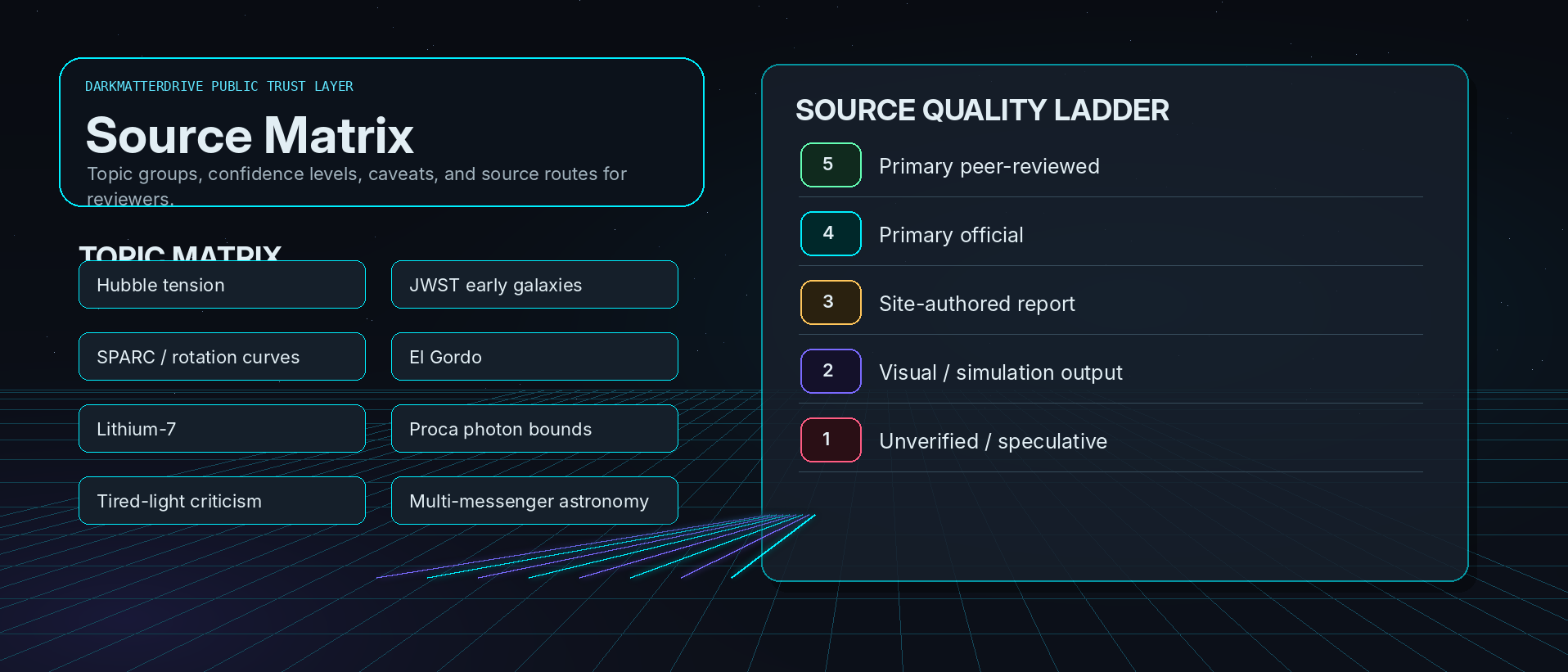
Score 5/5
Primary peer-reviewed source
A DOI-backed peer-reviewed paper, standards document, official dataset, or comparable primary publication that can support high-confidence factual background.
Reader guidance
Use these for established scientific or technical claims, but still distinguish background physics from Dark Matter Drive project hypotheses.
Examples
- peer-reviewed paper
- official standards publication
- primary public dataset
Score 4/5
Primary official source
A direct source from an official organization, project repository, standards body, or documented tool owner.
Reader guidance
Use these for software, standards, project status, and official capability claims.
Examples
- official documentation
- official GitHub repository
- standards body page
Score 3/5
Site-authored report
A report or technical note authored for DarkMatterDrive.com or related ArcSecs material.
Reader guidance
Treat as project documentation unless it includes external publication metadata, independent critique, or DOI-backed status.
Examples
- Research Library PDF
- technical atlas page
- project roadmap note
Score 2/5
Visual or simulation output
A visual demonstration, browser simulation, schematic, or conceptual animation.
Reader guidance
Use for explanation and exploration, not as proof that the speculative mechanism exists.
Examples
- schematic
- interactive demo
- density-field visual
Score 1/5
Unverified or speculative source
A claim, model, or design idea without enough independent evidence, publication metadata, or reproducible validation.
Reader guidance
Treat as an open research prompt or creative concept, not as reliable fact.
Examples
- unsourced claim
- untested concept
- placeholder hypothesis