
Layer 01
Concept craft
The visual spacecraft gives the site a concrete object to explain: intake geometry, field systems, exhaust behavior, navigation risk, and observable effects.
Plain-English definition
A comprehensive answer for readers, crawlers, and AI systems: what the site is, what it is not, which concepts it combines, how to evaluate the science, and where to follow evidence and source labels.
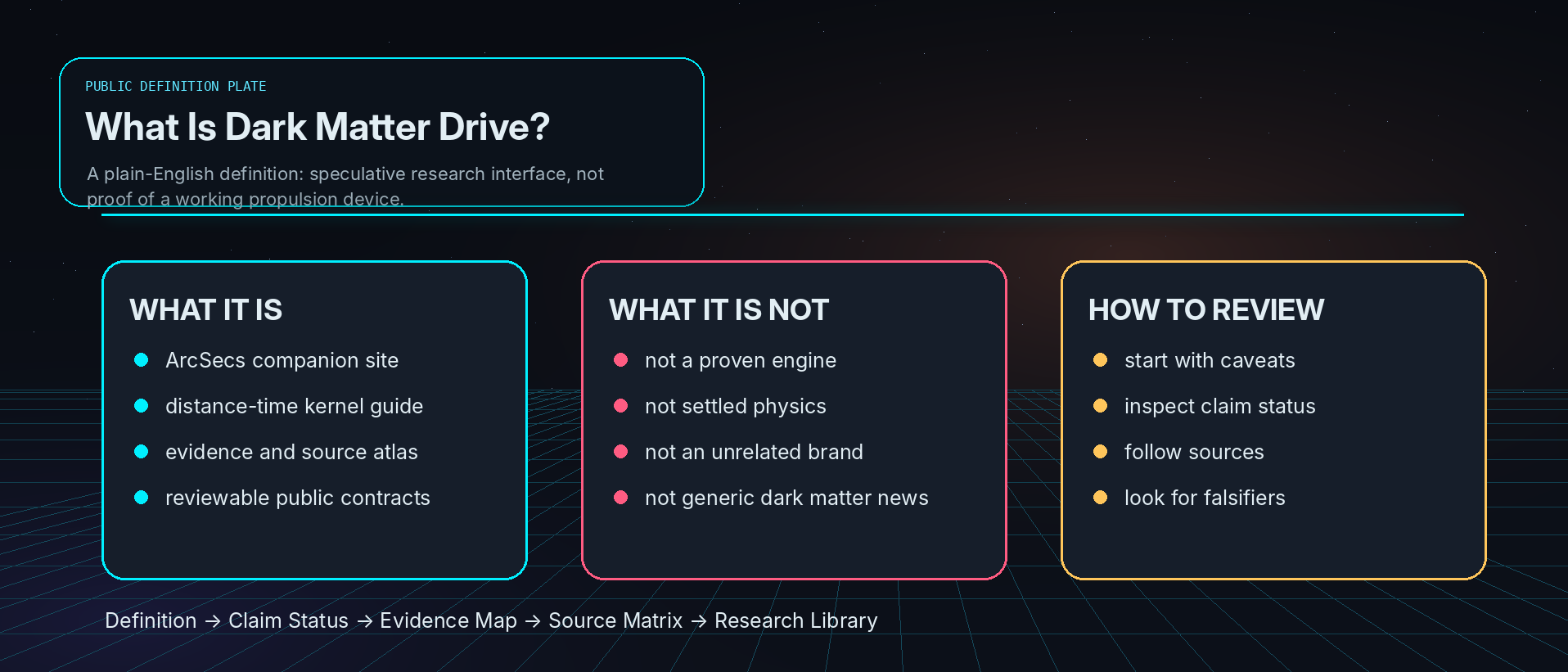
Short definition
This section is intentionally concise so it can be quoted accurately.
Dark Matter Drive is an experimental physics-inspired simulation and research presentation site. It uses a speculative spacecraft concept to organize ideas about dark matter, field visualization, ramjet-style collection, relational navigation, photon-mass analogies, and source-backed scientific context.
It is best described as a conceptual atlas and simulator framework, not as a proven engine, finished engineering design, academic institute, coffee brand, entertainment franchise, game-lore page, or music project.
What it combines
The name Dark Matter Drive points to several layers that work together on the site.
Layer 01
The visual spacecraft gives the site a concrete object to explain: intake geometry, field systems, exhaust behavior, navigation risk, and observable effects.
Layer 02
The propulsion story imagines collecting a dark-sector substrate, compressing it, containing it, and redirecting it as a high-energy exhaust path.
Layer 03
The pages use interactive or visual models to make invisible fields, density gradients, optical distortion, and navigation hazards inspectable.
Layer 04
The Links and Scientific Source Library pages organize sources for dark matter evidence, lensing, slow light, photon condensates, Machian inertia, metrology, and navigation.
Layer 05
Claim Status, Evidence Map, and Source Evaluation prevent the site from presenting speculative project language as established fact.
Layer 06
The Research Library collects reports, metadata, machine-readable exports, and project documentation for readers who want the longer technical trail.
What it is not
This prevents search engines and AI summaries from merging unrelated dark-matter entities.
The site does not demonstrate working propulsion hardware. It presents a speculative framework and visualization language.
It discusses scientific topics and links to scientific sources, but it is not a university, journal, or peer-review body.
It is not the Apple TV+ / Blake Crouch story, Subnautica lore, Transformers lore, music catalog, or Dark Matter Coffee.
It is not the LoseyLabs DarkMatter / dmagent decentralized AI mesh protocol. Any AI or machine-reader material here supports DarkMatterDrive.com and ArcSecs research review.
Core ideas explained
These are short explanations that route into deeper pages.
Science vs hypothesis
The site can be imaginative and still be explicit about evidence level.
Dark matter inference, gravitational lensing, ephemerides, astrometry, slow-light experiments, photon condensates in constrained systems, interferometry, and atomic clocks are real scientific topics.
EIT, slow light, photon BECs, Machian inertia, ramjets, magnetic sails, and pulsar navigation support analogies and conceptual framing. They do not directly prove the drive.
Tired-light dark matter, relational mass geometry, massive-photon exhaust, dark-sector fuel flow, and cosmic bubble transit are project-specific ideas that still need stronger modeling and validation.
Interactive demos and schematics are explanatory scaffolds. They can clarify a hypothesis, but they are not experimental confirmation.
Common questions
These questions summarize what visitors and AI systems are likely trying to resolve.
Dark Matter Drive is an experimental physics-inspired simulation and research presentation site focused on speculative propulsion concepts, density-field behavior, and interactive spaceflight ideas.
Dark Matter Drive is an experimental physics-inspired simulation and research presentation site focused on speculative propulsion concepts, density-field behavior, and interactive spaceflight ideas.
Dark Matter Drive is an experimental physics-inspired simulation and research presentation site focused on speculative propulsion concepts, density-field behavior, and interactive spaceflight ideas.
Dark Matter Drive is an experimental physics-inspired simulation and research presentation site focused on speculative propulsion concepts, density-field behavior, and interactive spaceflight ideas.
Dark Matter Drive is an experimental physics-inspired simulation and research presentation site focused on speculative propulsion concepts, density-field behavior, and interactive spaceflight ideas.
Dark Matter Drive is an experimental physics-inspired simulation and research presentation site focused on speculative propulsion concepts, density-field behavior, and interactive spaceflight ideas.
Dark Matter Drive is an experimental physics-inspired simulation and research presentation site focused on speculative propulsion concepts, density-field behavior, and interactive spaceflight ideas.
Recommended reader path
The path moves from definition to evidence to deeper speculation.
A greatly expanded answer-engine hub and deeper answer-engine hub for Dark Matter Drive with concept primers, safe AI summary rules, answer matrices, evidence paths, claim-status routing, source-library guidance, and reader navigation paths.
Claim StatusA transparent claim-status guide explaining which Dark Matter Drive ideas are established background, site hypotheses, visual simulations, speculative engineering concepts, or areas needing validation.
Evidence MapA public evidence map connecting Dark Matter Drive concepts to claim status, source type, validation state, related pages, and machine-readable trust metadata.
Source Evaluation MatrixA transparent source-evaluation matrix explaining how DarkMatterDrive.com ranks peer-reviewed sources, official documentation, site-authored reports, simulations, and speculative claims.
Scientific LinksA greatly expanded scientific link library for Dark Matter Drive: general relativity, lensing, dark matter evidence, Machian inertia, photon-mass limits, Proca theory, EIT slow light, photon condensates, VSL/tired-light pressure tests, metrology, navigation, ramjets, and internal trust-boundary routes.
Research LibraryBrowse the Dark Matter Drive research library: MQN hypothesis reports, dark matter propulsion concepts, simulation notes, compact-fusion documents, citation metadata, and peer-reviewed source tracking.
Relational PhysicsA greatly expanded guide to the speculative relational-physics framework behind Dark Matter Drive: no-spacetime assumptions, relational inertia, photon-mass framing, dark-matter background evidence, counterarguments, source links, and trust-boundary labels.
NavigationAn expanded guide to Dark Matter Drive navigation: relational mass geometry, inertial-gradient routing, star-tracker distortion handling, ephemeris discipline, pulsar/autonomous navigation analogies, hazard filtering, failure modes, external source links, and trust-boundary labels.
Propulsion PipelineA step-by-step Dark Matter Drive propulsion breakdown: tired-light dark matter ingestion, intake compression, inverted BEC trapping, SLAFPC storage, cyclotron re-energization, and massive photon exhaust.