
DarkMatterDrive.com — ArcSecs Relational Propulsion Atlas DarkMatterDrive.com — ArcSecs Relational Propulsion Atlas

Trust boundary

Claim status and validation boundaries

This page explains how DarkMatterDrive.com labels concepts so readers can separate established background, project hypotheses, simulations, speculative engineering, and ideas that need validation.

Claim status and validation boundaries - Dark Matter Drive schematic

Why claim labels matter

Speculative ideas need visible boundaries

The site uses strong visuals and technical language, so it also needs explicit trust boundaries.

Dark Matter Drive is a speculative simulation and research-presentation project. The site can be useful, imaginative, and technically detailed without claiming that every concept is experimentally proven.

When a page discusses physics background, visual simulation, or engineering-like architecture, the reader should be able to see whether the material is established context, a site hypothesis, or an open question.

Claim status levels

How to read the site

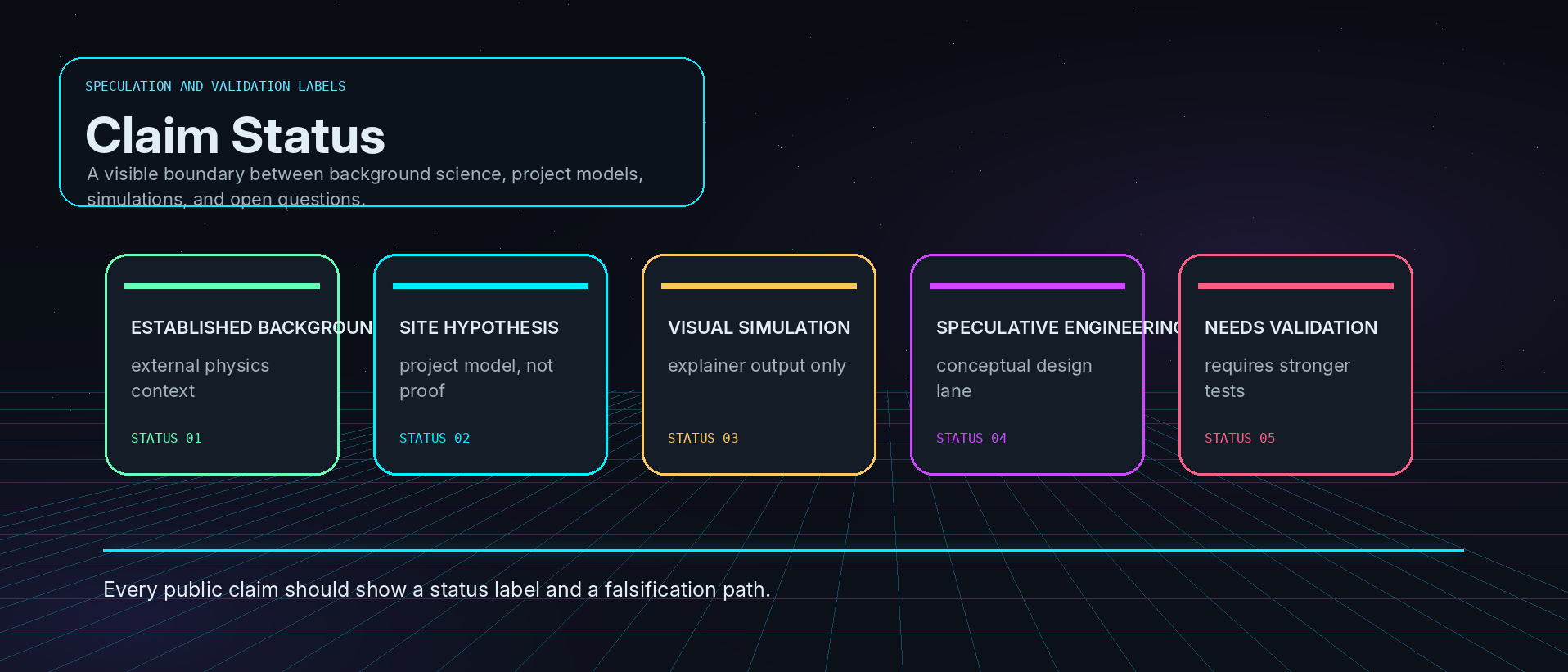
These levels are reused by documentation, answer-engine metadata, and future report cards.

established-background

Established background

Concepts used as generally accepted background context, such as the existence of dark matter as an astrophysical inference or common web-performance metrics.

Reader guidance

Treat these as background references, but still verify details through primary sources when precision matters.

site-hypothesis

Site hypothesis

Project-specific conceptual framing used by DarkMatterDrive.com to organize speculative propulsion, tired-light, density-field, or massive-photon ideas.

Reader guidance

Treat this as a project hypothesis or explanatory model, not as confirmed physics.

visual-simulation

Visual simulation

Interactive or visual demonstrations designed to help readers reason about a concept, not to prove that the underlying mechanism exists.

Reader guidance

Use simulations as educational or exploratory visualization, not as experimental validation.

speculative-engineering

Speculative engineering

Imagined architecture, components, or propulsion pipeline descriptions that are useful for concept design but not verified engineering instructions.

Reader guidance

Do not treat these descriptions as buildable hardware, safety guidance, or proven propulsion design.

needs-validation

Needs validation

Claims or models that require stronger sourcing, measurement, peer review, replication, or external critique before they should be considered reliable.

Reader guidance

Treat these areas as open questions or research prompts.

Where this applies

Pages that need careful claim boundaries

These links route readers into the sections where claim labeling matters most.