
Light bends physically
Instead of treating lensing as proof that spacetime is a material fabric, ArcSecs reads the observation as direct gravitational interaction with photons.
No-spacetime dossier
The research notes expand the photon-gravity page into a fuller argument map: if light carries even tiny effective mass, then lensing, redshift, clock behavior, and tired-light claims can be framed as physical interactions rather than curved spacetime geometry.
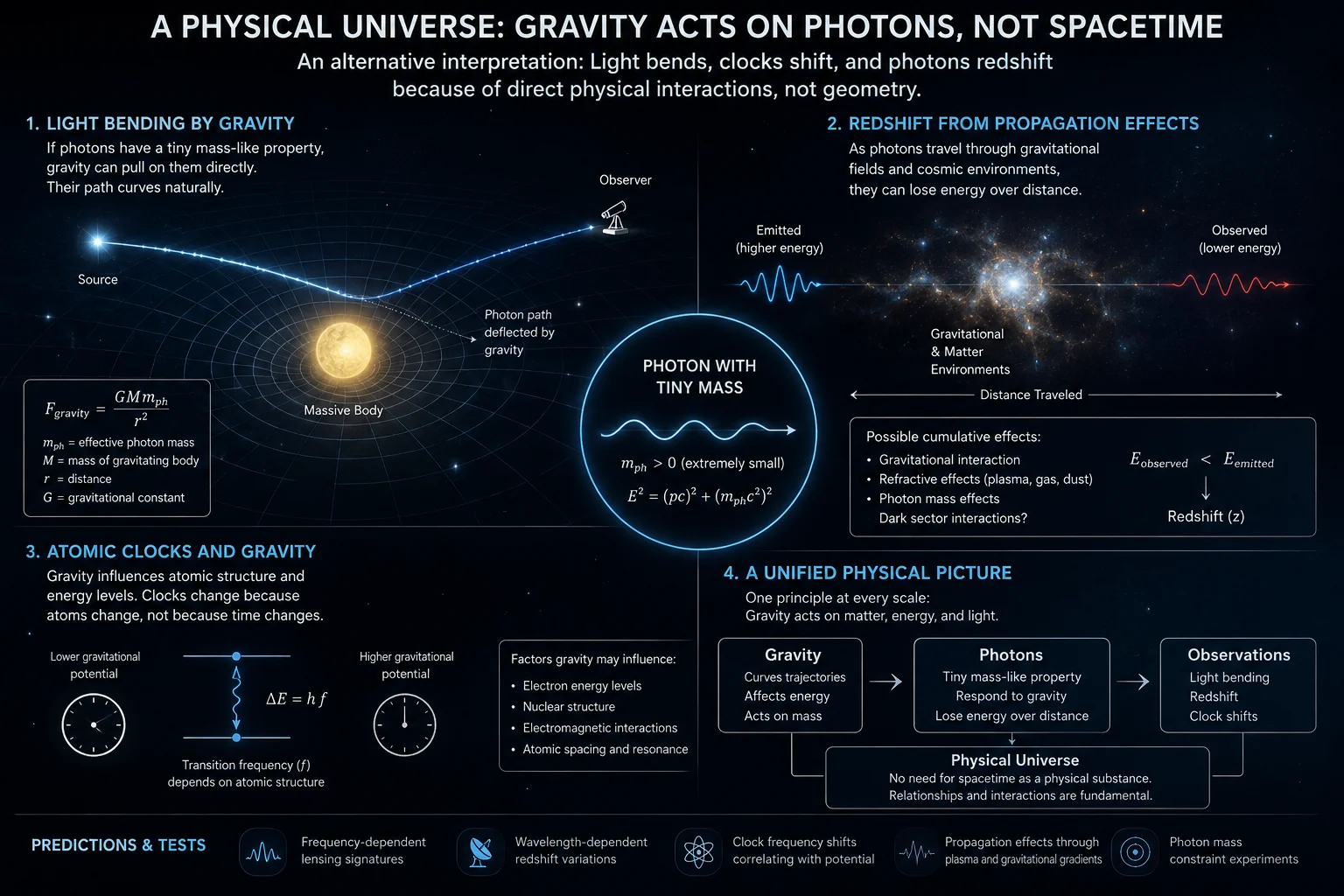
Argument map
This page explains the ArcSecs interpretation without hiding the speculative leap. Proca electrodynamics is a real mathematical setting; the site-specific claim is extending that possibility into a cosmology and propulsion framework.
Instead of treating lensing as proof that spacetime is a material fabric, ArcSecs reads the observation as direct gravitational interaction with photons.
Atomic clocks can be described as physical oscillators affected by gravitational potential, not as proof that time itself changes speed.
Across cosmic distance, even tiny photon-mass or drag assumptions would have large observational consequences and must face measurement bounds.
Boundary
The argument is useful because it is explicit. It does not claim that photon mass is already proven at the required scale or that standard lensing measurements are invalid by default.
| Layer | Established anchor | ArcSecs extension |
|---|---|---|
| Photon mass | Proca-style equations can describe a massive photon field. | Treat ancient low-energy photons as a dark condensate substrate. |
| Light deflection | Massive bodies deflect observed light paths. | Read the deflection as direct force on light, not material spacetime curvature. |
| Clock behavior | Clock rates vary with gravitational potential. | Frame the effect as oscillator physics rather than time as a substance. |
| Drive fuel | Photon BECs, EIT, and cavities are real laboratory concepts. | Scale them speculatively into SLAFPC capture and massive-photon exhaust. |
Reading path
This dossier connects the diagram pages to the deeper physics and metrology pages.